
The train pulls into Oxford station on a Monday morning in March, and you step out into air that smells faintly of rain and old stone. You have been to cities before. You have been to schools, to exams, to competitions. But you have never been to this. The BPhO training camp is not a school trip. It is not a holiday. It is not even, strictly speaking, a competition. It is something else entirely — a week in which the best young physicists in the country are gathered together in one of the oldest universities in the world, and asked to become more than they thought they could be.
You walk through the city centre, past the honey-coloured buildings and the spires that have watched over scholars for eight hundred years, and you feel the weight of it — not as a burden but as a kind of gravity, a quiet pull that draws you forward. Newton walked these streets. Halley walked these streets. Hooke, Wren, Dirac, Hawking — all of them passed through this city, sat in these halls, argued in these courtyards. And now you are here, with a suitcase full of clothes and a head full of equations, and for the next week, you are part of this story too.

Monday Morning: The Gathering
You arrive at the college that is hosting the camp this year — the location changes from year to year, but the atmosphere is always the same. There is a porter's lodge, and a courtyard, and a sense of quiet order that makes you want to walk more slowly and speak more softly. You sign in, collect your room key, and are directed to the common room where the other students are gathering.
There are about twenty of you — the top performers from Round 2, the students who scored high enough to be invited to this week. You recognise a few faces from the exam itself, but most of them are strangers. They come from all over the country — from large comprehensives in Manchester, from small grammar schools in Kent, from independent schools in London, from academies in Glasgow and Belfast and Cardiff. They are, you will discover over the course of the week, some of the most extraordinary people you have ever met.
You sit down with a cup of tea, and the person next to you introduces themselves. They are from a school you have never heard of, in a town you cannot place on a map, and they are — you will realise over the next hour — absolutely brilliant. They solved a problem in Round 2 that you could not even begin. You feel a flicker of something — envy, perhaps, or admiration, or both — and then you let it go, because you are here to learn, not to compete. The competition is over. This is something else.
Tuesday: The First Lecture
The first lecture is in a room that looks like it was designed for the sole purpose of making you feel small. The ceiling is high and vaulted, the walls are lined with portraits of former fellows, and the desks are arranged in tiered rows that slope down towards a central podium. You take a seat near the front, and you wait.
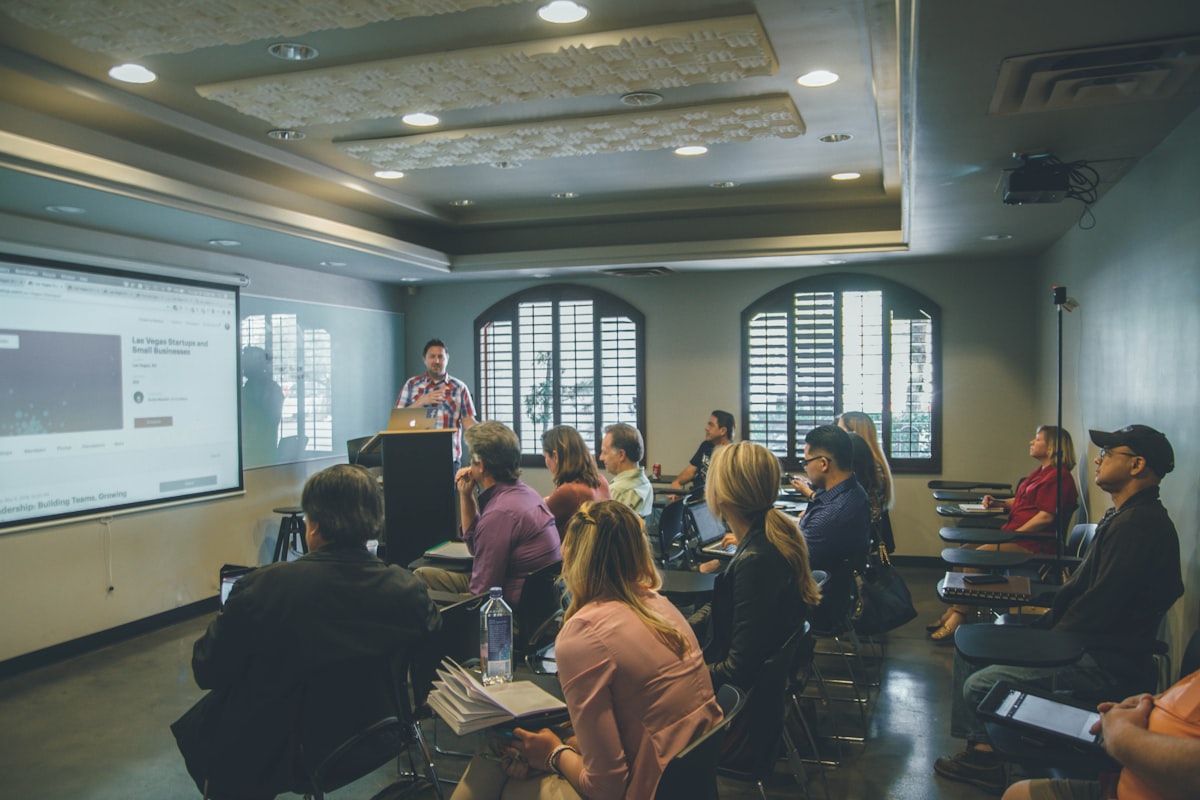
The lecturer is a professor from the physics department — someone whose papers you may have read, or whose textbooks you may have struggled through, or whose name you recognise from the acknowledgements in Kleppner and Kolenkow. They do not begin with a recap of what you already know. They begin with a question that you have never thought to ask, and within five minutes, they have dismantled a concept you thought you understood and rebuilt it in a form that is more elegant, more general, and more powerful than anything you had encountered before.
The lecture is not about facts. It is about ways of seeing. The professor takes a familiar problem — a charged particle in a magnetic field, say, or a system of coupled oscillators — and shows you how to look at it from an angle you had never considered. They introduce a technique that is not in any A-level textbook, and not in most first-year university courses either, and they show you how it turns a hard problem into an easy one. You take notes furiously, and you feel your brain stretching in ways it has never stretched before.
Wednesday: The Problem Session
In the afternoon, the lectures give way to problem sessions. This is where the real work happens. You are given a set of problems — not A-level problems, not even BPhO Round 2 problems, but problems that are genuinely at the frontier of what is possible for a pre-university student. They are beautiful, and they are hard, and they are designed to push you further than you have ever been pushed before.
You work in small groups, with a coach — usually a graduate student or a young researcher — circulating between the tables, offering hints when you are stuck, challenging your assumptions when you are too comfortable, and occasionally sitting down to work through a step with you when the whole group is lost. The coach does not give you the answer. They ask questions. "What symmetry do you notice? What happens if you change the coordinate system? What is the limiting case when this parameter goes to zero?" Each question is a key, and you have to find the lock yourself.
There is a moment, about an hour in, when something clicks. A problem that has been resisting you for forty minutes suddenly yields — not because you have found the right equation, but because you have finally seen the problem clearly. The solution pours out of you, almost involuntarily, and you write it down with a hand that is shaking slightly, and when you finish, you look up and see that the coach is smiling, and the person next to you is nodding, and you feel a satisfaction that is deeper than any exam result could provide.
Thursday: The Laboratory
Thursday is the experimental day. You move from the lecture rooms to the laboratories, and the character of the week changes. The physics becomes physical. You are not just manipulating symbols on paper any more — you are holding equipment, aligning lasers, measuring voltages, watching oscilloscope traces dance on a screen.
The experiment is a sophisticated one — something involving optics and electronics, with a setup that takes twenty minutes to assemble and another twenty to calibrate. You work in pairs, and you discover that your partner has a talent for the practical aspects that you lack: they can align a laser beam to sub-millimetre precision, they can read a scale through a magnifying glass without parallax error, they can solder a circuit without burning their fingers. You, in turn, are better at the analysis — at setting up the error propagation, at linearising the data, at extracting the relationship from the noise. Together, you are more than the sum of your parts.

At the end of the day, you write up your results, and you hand them in, and you feel the particular tiredness that comes from a day of sustained practical work — a tiredness that is different from the mental exhaustion of a problem session, more physical, more embodied, as if the physics has entered your hands and your eyes and settled there for the night.
Friday Evening: The Courtyard
On Friday evening, the formal programme ends for the day, and the students gather in the courtyard. The sun is low, and the light is golden, and someone has produced a football from somewhere, and a game begins that has no rules and no score and lasts for as long as the light holds.

You sit on the edge of the courtyard and watch, and the person who solved the problem you couldn't sits down next to you, and you talk. Not about physics — or not only about physics. You talk about school, about family, about what you want to do with your life. You talk about the fear of not being good enough, and the relief of discovering that everyone else feels it too. You talk about the moment in the problem session when everything clicked, and the moment when nothing did, and the strange, quiet pride you feel at having made it through the week.
You realise, as the light fades and the first stars appear above the spires, that these people — these strangers who became friends over five days of shared effort — will be part of your life for a long time. Not all of them. But some of them. The ones you argued with over a derivation, the ones you laughed with in the dining hall, the ones who sat next to you in the lecture theatre and whispered, "Do you understand this?" And you said, "No," and they said, "Me neither," and you both kept taking notes.
Saturday: The Library
On Saturday morning, before the final session, you slip away to the college library. It is a small library, not the Bodleian, but it is old, and it smells of paper and dust and time, and the shelves are lined with books that have been read by generations of physicists before you. You pull one out at random — a collection of Feynman's lectures, perhaps, or a treatise on classical mechanics from the 1950s — and you open it, and you read a passage that makes you stop and think, and then you close the book and put it back, and you sit for a while in the silence, listening to the sound of your own breathing and the distant sound of footsteps on stone.
You think about the week, and about what it has meant. It has been the hardest week of your academic life, certainly. But it has also been the most joyful. There is a particular kind of joy that comes from being in a room full of people who care about the same things you care about, who find the same problems beautiful, who get the same thrill from a clean derivation or an elegant approximation. It is a joy that is hard to find elsewhere, and you know, even as you sit there, that you will miss it when the week is over.
Sunday: The Last Morning
On Sunday morning, you pack your suitcase. The room is empty now, stripped of the books and papers and half-drunk cups of tea that accumulated over the week. You look around one last time, and you feel the strange melancholy that comes with leaving a place that has, briefly, felt like home.

Downstairs, in the common room, the final session is taking place. The coaches are there, and the professor who gave the first lecture, and they are saying the things that people say at the end of these gatherings: thank you, well done, keep going, don't stop. They tell you that the selection for the IPhO team will be announced in the coming weeks. They tell you that whatever the result, you should be proud of what you have done. They tell you that the physics does not end here — that it is a journey, not a destination, and that the best problems are the ones you have not yet encountered.
You listen, and you nod, and you feel the truth of what they are saying settle into you like the light into the old stone outside. You will go home. You will go back to school, to A-levels, to the ordinary rhythms of your life. But you will not be the same. You have spent a week in a place where physics is not a subject but a way of life, and you have discovered that you love it — not just the problems, not just the results, but the community, the conversation, the shared pursuit of understanding that binds this strange, wonderful, improbable group of people together.
The Train Home
The train pulls out of Oxford station on Sunday afternoon, and you watch the city recede through the window — the spires, the lawns, the river, the ancient, patient stone. You have a notebook on your lap, full of equations and diagrams and the names of people you hope to see again. You have a phone full of photographs — the chalkboard from the problem session, the oscilloscope trace from the lab, the courtyard in the evening light, the library where you sat and breathed and remembered why you started.

You think about the IPhO team. You think about whether you will be chosen, and you feel the familiar mixture of hope and fear, and then you let it go, because the coaches were right: the physics does not end here. Whatever happens next — whether you are on the team or not, whether you win a medal or not — you have already won something that no one can take from you. You have spent a week at Oxford, in the company of the best young physicists in the country, and you have discovered that you belong. Not because you are the best, but because you care. Because you look at a problem and feel the pull of it, the need to understand, the joy of the solution. Because you are, in the deepest sense, a physicist.
The train rounds a bend, and Oxford disappears behind a line of trees, and you open your notebook to the first page, and you begin to write. Not equations — not yet. Just a thought, a feeling, a sentence that you want to remember:
"The best week of my life so far. And the physics is only just beginning."