Our tutoring courses are equipped with exclusive self-developed teaching materials, and our instructors are all graduates of prestigious universities at home and abroad with rich experience in competition teaching. We also offer different classes for students with different levels of knowledge, so as to truly achieve targeted instruction and twice the result with half the effort!
Instructor Team
Teacher Huang
Graduated from the Mathematics and Physics Base Program at Southeast University, and later pursued a Master's degree in Aerospace Engineering at George Washington University in the United States.
7 years of overseas teaching experience in international courses and competitions.
Teaching Achievements:
2023 BPHO: 13 Super Gold Medals, 14 Gold Medals, 6 Silver Medals, 3 Bronze Medals, 6 students advanced to Round 2 with scores exceeding 54 points.
2022 BPHO: 13 students won Super Gold Medals, 8 won Gold Medals, 10 won Silver Medals, and 3 won Bronze Medals.
Other: 1 student admitted to Oxford University, 2 students received interview invitations from Oxford University, 1 student received an interview invitation from Cambridge University, and 1 student admitted to the University of Pennsylvania.
Teacher Zhang
Bachelor of Physics from Zhejiang University;
Master of Physics from Brown University;
AP Certified Teacher by the College Board.
Undergraduate and graduate advisors were Prof. F. Malte Grosche of the Cardiff Laboratory at Cambridge University and Leon N. Cooper, the 1972 Nobel Prize laureate in Physics and proposer of the BCS theory.
After graduation, he has been engaged in international science education. In 2022, he completed research on the construction of invasive brain-computer interface algorithms at the New Hope Fertility Center in the United States.
In teaching, he combines the characteristics of domestic and international teaching systems to help students develop a strong sense of exploration and logical thinking.
Proficient in AP, A-level, IB, and other international science physics courses, as well as various physics competitions.
Student Achievements
IPC & SPC Online
🏆 2025
14 Gold, 7 Silver, 1 Bronze
BPhO (British Physics Olympiad)
🏆 2024
Round 1: 9 Super Gold Awards, 20 Gold Awards, 20 Silver Awards, 12 Bronze Awards; Round 2: 4 Silver Awards, 2 Bronze Awards.
🏆 2023
Round 1: 19 Super Gold Awards, 9 Gold Awards, 10 Silver Awards, 17 Bronze Awards; Round 2: 4 Silver Awards, 2 Bronze Awards.
🏆 2022
Round 1: 8 Super Gold Awards, 11 Gold Awards, 14 Silver Awards, 31 Bronze Awards (14 Bronze Awards + 2 17 Bronze Awards); Round 2: 4 Silver Awards, 2 Bronze Awards.
🏆 2021
Round 1: 8 Super Gold Awards, 11 Gold Awards, 14 Silver Awards, 31 Bronze Awards (14 Bronze Awards + 2 Bronze Awards); Round 2: 1 Gold Award, 1 Silver Award, 4 Bronze Awards.
🏆 2020: 6 Super Gold Awards, 3 Gold Awards, 8 Silver Awards, 20 Bronze Awards, winning rate 70%.
🏆 2019: 4 Super Gold Awards, 5 Gold Awards, 1 Silver Award, 5 Bronze Awards.
Intermediate & Advanced Challenges
🏆 2023: 1 Bronze Award, 2 Silver Awards.
🏆 2021: 6 Gold Awards, 2 Silver Awards.
🏆 2020: 2 Gold Awards.
IPC & SPC Tutoring Course
Suitable for:
Students aiming for SPC (Gold, Silver, Bronze) & IPC (Gold) awards
Preparing for BPHO
Course Content:
1. Data and Estimation
2. Electricity and Circuits
3. Forces and Dynamics
4. Kinetics 1
5. Kinetics 2
6. Liquids and Gases
7. Magnetism
8. Oscillations
9. Particle Physics
10. Thermodynamics
20 hours + 5 practice exam sessions (10 hours)
Total 30 hours
BPHO (British Physics Olympiad) Comprehensive Tutoring Course
Course Objectives
Systematically improve physics knowledge and aim for BPHO awards.
Course Features
Seamlessly bridges the gap to top-tier British physics competitions, boosting academic background and paving the way for admission to prestigious universities.
BPHO Challenge Course Prerequisites
1. For middle school physics content, mastery of G7-G8 curriculum content is required. For example, A-Level students need to master IGCSE curriculum content (General Physics, Thermal Physics, Electromagnetism, Optics, Wave, Nuclear Physics).
BPHO Course Prerequisites:
For A-level students, mastery of all A-level physics knowledge points is required.
AS Physics: Mechanics, Materials Science, Waves, Circuits, Electric Fields, Momentum, Data Analysis, and Nuclear Physics, etc.
A2 Physics: Circular Motion, Magnetic Fields, Photoelectric Effect, Quantum Mechanics, Simple Harmonic Motion, Thermodynamics, etc.
For AP students, a foundation in AP Physics 1 or 2 (ideally 5 points) is recommended. C foundation preferred
For IB students, it is recommended to master the IBDP Physics HL knowledge points in advance
Target audience
G8-G11 students interested in physics, chemistry, and engineering
Class duration
Total 100 (40+60) hours of knowledge point explanation
Course outline
BPHO Challenge Plan
Part 1: Basic knowledge points (20)
Mechanics (6)
Kinematics
Dynamics
Static Equilibrium
Work, energy and Power
Momentum
Matter and Materials
Density and Pressure
Upthrust
Young Modulus
Electricity (6)
Electric current
Resistance and resistivity
Practical circuits
Waves (6)
Progressive waves
Wave characteristics
Polarization
Superposition of Waves
Interference and double-slit interference of light
Diffraction
Stationary Waves
Nuclear Physics (2)
Radioactivity, atoms, nuclei and radiation
Fundamental particles
Part 2: Advanced knowledge points (20)
Mechanics Mechanics (2)
Circular Motion
Gravitational Fields
Gravitational field strength g
Energy in a gravitational field
Oscillations
Free and forced oscillations
S.h.m.
Damped oscillations
Thermal Physics (2)
Internal energy
The meaning of temperature
Ideal Gases
Ideal gas equation
Modeling gases – the kinetic model
Temperature and molecular kinetic energy
Electricity (4)
Coulomb’s Law
Electric Potential
Capacitance
Electromagnetism (4)
Magnetic force
Magnetic flux density
Motion of charged particles
Electromagnetic induction
Alternating Current
Quantum and nuclear physics (4)
Photoelectric Effect
Energy Levels
Wave-particle duality
Nuclear physics
Binding energy and stability
Radioactive Decay
Astronomy (2)
Astronomy and cosmology
BPHO plan
Part 1: Mechanics and Electromagnetism (This part is the most important basic course in physics and is also the focus of the competition) (26)
One-dimensional motion (2)
Two-dimensional motion (2)
Forces and Newton’s Laws (2)
Circular motion (2)
Gravitation and Satellites (2)
Work and Energy (2)
Momentum and Collisions (2)
Fluids (2)
Electric Field (4)
Electric Circuit (2)
Magnetic Field (2)
Electromagnetic Induction (2)
Part 2: Waves, Thermodynamics, Optics, Modern Physics (This part is relatively abstract and difficult for high school students. Students need to complete a solid foundation of knowledge before studying it) (24)
Oscillatory Motion (4)
Mechanical Waves (4)
Temperature and Heat (1)
Kinetic Theory of Gases (1)
Laws of Thermodynamics (4)
Ray optics (2)
Wave optics (4)
Atomic Physics (4)
Part 3: Comprehensive Review and Explanation of Past Exam Questions (10)
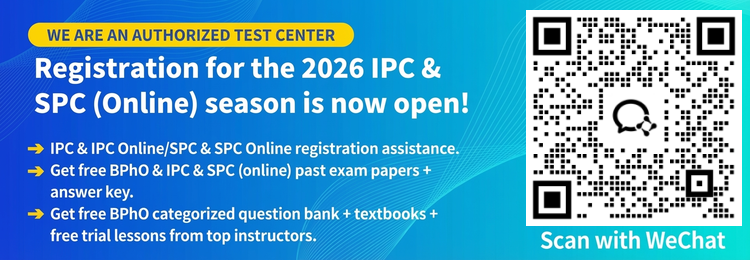
Scan the QR code to learn more about the course and try out a lesson taught by a renowned instructor.
Receive course discounts + one-on-one academic planning!