

What is the BPhO Physics Competition, a physics competition that approximately 70% of students admitted to Oxford and Cambridge's Physics and Engineering departments have participated in?
The BPhO Physics Competition stands for British Physics Olympiad. It is the highest-level high school physics competition in the UK, established in 1979, and became the qualifying competition for the British national team of the International Physics Olympiad (IPhO) in 1983.
The BPhO governing board office is located in the Department of Physics at Oxford University. The five main members of the board currently consist of experts from Oxford University, Cambridge University, King's College, and other institutions. BPhO is primarily aimed at British students, but also accepts participation from students outside the UK.
BPhO comprises a series of physics competitions at different levels for secondary school students of different grades. These include: the Junior Physics Challenge (British Secondary Physics Olympiad), the Intermediate & Senior Physics Challenge (British Physics Thinking Challenge), BPhO Round 1, and BPhO Round 2.
Registration for the 2026 IPC & SPC season is now open!
We are an authorized test center.
ASDAN non-partner school students, independent students, and students from overseas regions can all register on our behalf by scanning the QR code ⇓
2026-2027 BPhO Series Competition Schedule
| Event Name | Application deadline | Match time |
| BPhO Round 0 | - | September 30, 2026, 17:00-18:00 |
| IPC&SPC Online | January 25, 2027 | February 3, 2027, 17:00-18:00 |
| IPC&SPC | February 22, 2027 | March 5, 2027, 17:00-18:00 |
| IPC & SPC Finals | Pending | June 26, 2027 |
|
BPhO Round 1 |
Registration will be conducted in batches. The deadline for the first batch is August 1, 2026; the deadline for the second batch is September 1, 2026. |
November 10, 2026, 17:00-19:00 |
| BPhO Round 2 | February 9, 2027 | February 21, 2027, 14:00-17:00 |
Starting in 2026, the number of BPhO test slots in China (including Hong Kong and Macau) will be strictly limited to 3,500. Of these, 3,400 slots will be prioritized for winners of the UK Physics Assessment (Advanced) SPC and SPC Online, and the UK Physics Assessment (Intermediate) IPC and IPC Online. Additionally, 100 slots will be reserved for the top 100 students with R0 scores in the current year.
Registration for the 2026 BPhO will be conducted in four batches:
First Batch (Priority Allocation):
For those who won a Global Gold or Silver Award in the 2026 Advanced SPC and a Global Gold Award in SPC Online.
For those who won a Global Gold Award in the 2026 Intermediate IPC and IPC Online.
Registration deadline: August 1, 2026.
Second Batch (Allocation):
If there are remaining places in the first batch, they will be allocated to:
For those who won a Gold or Silver Award in the 2026 Advanced SPC and a Global Silver or Bronze Award in SPC Online;
For those who won a Global Silver or Bronze Award in the 2026 Intermediate IPC and IPC Online.
If the first batch is full, registration for the second batch will not be open.
Registration deadline: September 1, 2026.
Independent Allocation:
For students who scored above the undetermined minimum score in the 2026 BPhO Round 0. R0 is open to all students with no limit on the number of places available.
Remaining Places:
After the initial allocation of places is completed, any remaining places will be allocated on a first-come, first-served basis until all places are filled. Registration will close once all places are filled.
BPhO Competition Key Events Introduction
Competition Difficulty Ranking
JPC < IPC Online < IPC < SPC Online < SPC < BPhO Round 1 < BPhO Round 2
| BPhO Round1 | IPC&SPC Online | BAAO |
| BPhO Round2 | IPC&SPC |
Why is the BPhO recommended?
1. Increased Application Competitiveness
As a competition closely associated with Oxford University, BPhO results are highly recognized when applying to science and engineering programs at UK universities, especially physics, engineering, and materials science. Past data shows that approximately 70% of students who participate in the BPhO competition are admitted to the Department of Physics and Engineering at Oxford University.
2. Facilitates Applications to Prestigious Universities
BPhO questions are highly relevant to interview questions at Oxford and Cambridge Universities. The BPhO competition provides students with valuable experience in preparing for these universities' written exams and interviews. Based on past student applications, the difficulty level of BPhO questions is generally comparable to that of Oxford and Cambridge physics exams, and includes some A2 level content.
3. Enhanced Academic Ability
Participating in the BPhO competition can improve students' academic ability, enhancing their mastery of physics concepts and proof methods, as it emphasizes the ability to apply physics knowledge flexibly. Furthermore, when applying to physics programs, participating in physics competitions is one of the most effective ways to enhance personal competitiveness.
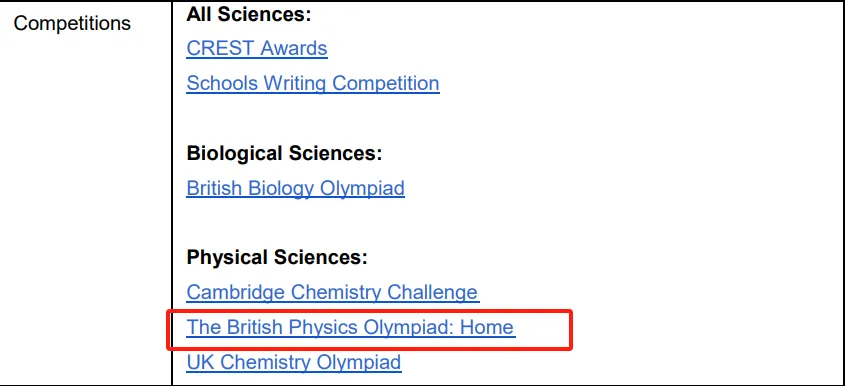
*List of Cambridge University extracurricular academic activities, with recommended competitions in the natural sciences including BPHO.
Types of BPhO Competitions Available for Different Grade Levels
The BPhO Physics Competition is divided into 13 types, offering different levels and formats for students in UK Year 10-13 (Years 9-12 in China).
Based on the competition concept, they can be divided into two main categories: Physics Challenge and Physics Olympiad.
The main competition that most people are familiar with actually belongs to the Physics Olympiad.
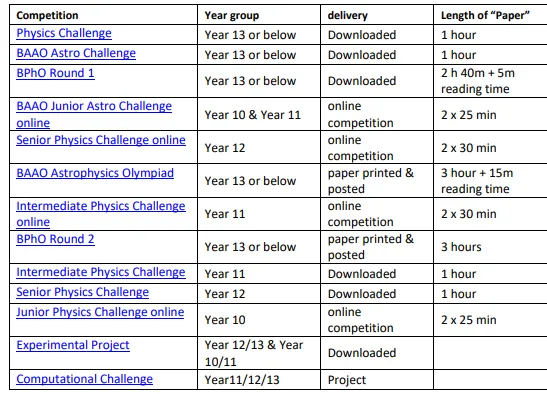
The Physics Challenge series is divided into three categories:
1. Junior Physics Challenge (JPC)
Students in Year 9 or with Year 9 level or equivalent can choose to participate in the Junior Physics Challenge (JPC). This is an introductory-level physics competition suitable for students trying competitions for the first time.
The exam content is based on the IGCSE curriculum, but some questions are related to everyday knowledge, covering topics such as dynamics, electricity, optics, thermodynamics, waves, units, and a small amount of astronomy.
2. Intermediate Physics Challenge (IPC)
Students in Year 10 or with Year 10 level or equivalent can choose to participate in the Intermediate Physics Challenge (IPC).
This competition features novel question formats, including multiple-choice and short-answer questions. The difficulty is slightly higher, but the knowledge points are not beyond the syllabus.
Click here to access JPC past exam papers.
3. Senior Physics Challenge (SPC)
SPC Senior: Suitable for Year 11 or AS physics level students, 2 x 30 minutes, focusing on the application of principles, with questions mainly consisting of short and long answers.
BPhO Physics Olympiad
BPhO Round 1 is the preliminary round of the British Physics Olympiad and the most participated BPHO series competition among Chinese students.
BPhO Round 1 is suitable for students in Year 13 and below with a good level of physics knowledge. This competition places great emphasis on the application of physics knowledge, with questions mainly consisting of proofs. The questions cover a wide range of topics and are quite challenging.
BPhO Round 2, as an advanced stage of the British Physics Olympiad, is more difficult than Round 1 and is suitable for students with stronger academic abilities and a more solid foundation in physics.
BPhO Preparation Essential Reading List
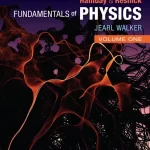
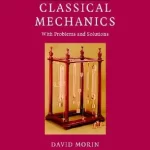
High-definition PDF download link
The newly compiled BPhO lecture notes are here!
Highlights:
References to University Physics Lecture Notes:
The lecture notes were compiled with reference to numerous books, primarily a university physics lecture series. The author of the lecture series shared examples from that series, and some important examples in the notes are taken from it.
Integration of Competition Content:
The lecture notes also incorporate BPhO content, mainly combining physical models summarized from past exam questions.
Reviewed and Revised by Physics Department Teachers:
In addition, other physics teachers reviewed the lecture notes, and the teacher who created the end-of-chapter exercises reorganized them according to past exams and different chapters, placing them at the end of each chapter as supplementary assignments, thus improving the lecture notes' relevance to the exams.
Valuable Student Suggestions:
Furthermore, each chapter includes invaluable suggestions from students for revising the lecture notes. The lecture notes are continuously improved, and minor errors are constantly being reduced.
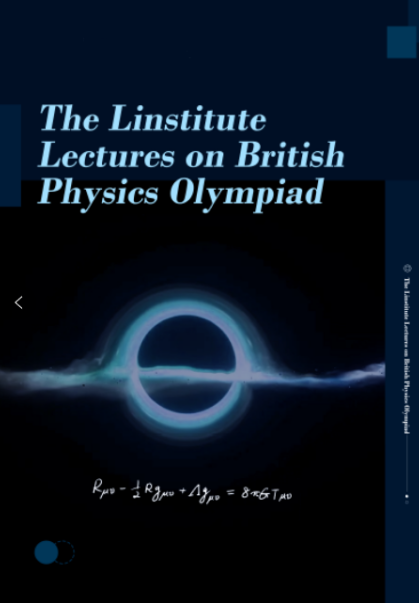
Scan the QR code to inquire, first come, first served!
BPhO Management Committee
In its day-to-day operations, BPhO is managed by a five-member committee and a large team of volunteer physics teachers and scholars from across the country. The Management Committee guides BPhO, coordinates activities and training camps, and oversees its overall operation.
Key Members of the Management Committee
Mr. Robin Hughes (Isaac Physics isaacphysics.org, formerly King's College Wimbledon) - Chairman
Dr. Anson Cheung (Highgate School, London, formerly Trinity College, Cambridge)
Mr. Iain Holmes (Buccleuch College, Kettering)
Dr. Sian Owen (Department of Physics, University of Oxford) - Administrator
Mrs. Claire Thomson (Former Department of Education, Institute of Physics - Retired)
Address
The administrative office is located at: BPhO, Department of Physics, University of Oxford, Denys Wilkinson Building, Oxford OX1 3RH
Lena Shams is the Administrative Secretary of BPhO, University of Oxford. She can answer your questions about the competition. For inquiries, please contact Contact@bpho.org.uk.