
In a collision problem, can you use both conservation of momentum and conservation of kinetic energy? Before writing equations, check the system and the collision model. Those two decisions determine which relationships you can use.
This British Physics Olympiad preparation guide uses an original two-cart exercise to practise that choice. It is suitable for students who have studied momentum and kinetic energy and want to explain their mechanics reasoning more clearly.
Know the formulas but unsure which one to use? Try the exercise below, then scan the QR code to contact Hanlin. Send BPHO MOMENTUM with your year or grade, current physics course and target competition to discuss your preparation starting point.
1. Check the conditions before choosing a conservation law
The total momentum of a chosen system is conserved when the net external impulse on it is zero. For a short collision on a horizontal track, we may model the external horizontal impulse as negligible and conserve horizontal momentum.
Kinetic energy needs a separate check. In an elastic collision, the system's total kinetic energy is conserved. In a perfectly inelastic collision, the objects stick together and generally have less kinetic energy afterwards. A collision in which objects bounce apart is not automatically elastic.
For further study of these definitions, see OpenStax's chapter on types of collisions.
2. Original exercise: two carts stick together
Cart A has mass 2 kg and moves to the right at 3 m/s. Cart B has mass 1 kg and is initially stationary ahead of A. They collide on a horizontal track and stick together.
Model the external horizontal impulse during the collision as zero. Treat the motion as one-dimensional and consider the carts' translational kinetic energy. Find their shared velocity immediately after the collision, then compare the total kinetic energy before and after.
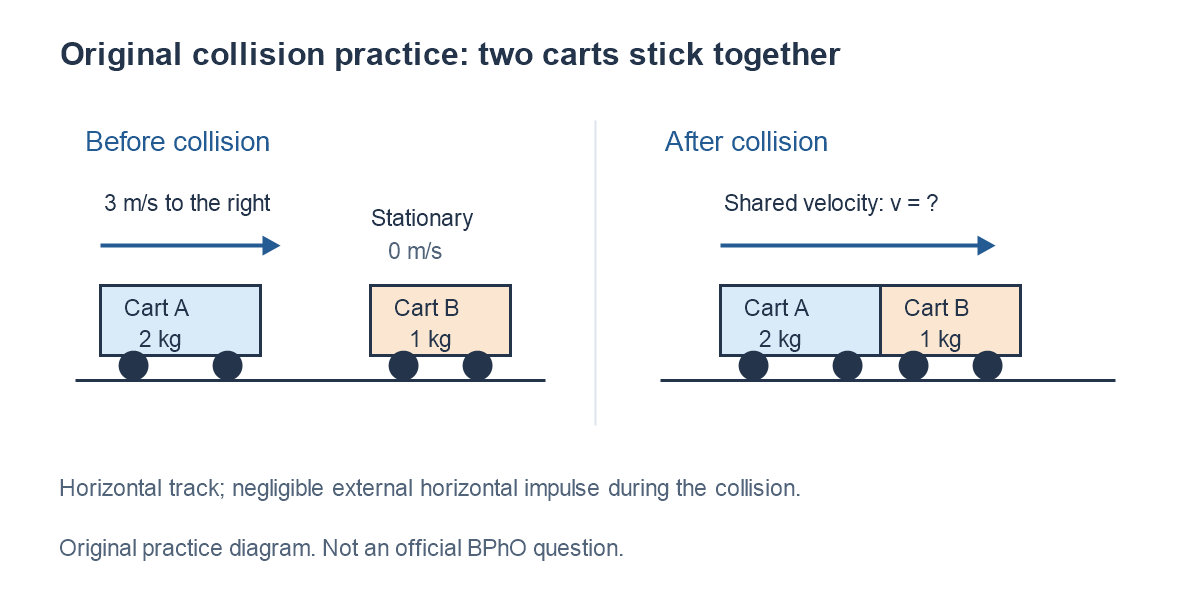
Before reading the solution, write down your system, positive direction and reason for choosing a conservation law. This exercise is a concept check, not a prediction of a competition question or an official difficulty benchmark.
3. Define the system and keep the signs
Choose both carts together as the system and take right as positive. The large forces the carts exert on each other are internal to this system. Their horizontal impulses cancel in the total momentum balance.
Cart A alone does not conserve its momentum during the collision: Cart B exerts a force on it. Choosing the system is therefore part of the reasoning, not just a label on the diagram.
Because the carts stick together, both have the same final velocity v. Conservation of horizontal momentum gives:
2 × 3 + 1 × 0 = (2 + 1)v
6 = 3v
v = 2 m/s to the right.
The total momentum is 6 kg m/s before and after. We did not need to assume that kinetic energy was conserved to find this velocity.
4. Calculate kinetic energy independently
Before the collision, only Cart A is moving:
Kbefore = ½ × 2 × 32 + ½ × 1 × 02 = 9 J.
After the collision, the combined 3 kg mass moves at 2 m/s:
Kafter = ½ × 3 × 22 = 6 J.
| Quantity for the two-cart system | Before | After |
|---|---|---|
| Total horizontal momentum | 6 kg m/s | 6 kg m/s |
| Total translational kinetic energy | 9 J | 6 J |
The kinetic energy decreases by 3 J, or one-third of its initial value. Energy can be transferred into deformation, thermal energy and sound. This decrease does not mean total energy has been destroyed; kinetic energy is only one form of energy.
5. What changes if the collision is perfectly elastic?
Keep the same masses and initial velocities, but now specify a perfectly elastic collision. The carts do not stick together, so give them separate final velocities vA and vB. Both total momentum and total kinetic energy must match their initial values:
2vA + vB = 6
vA2 + ½vB2 = 9
Substitute vB = 6 - 2vA into the energy equation. This gives vA2 - 4vA + 3 = 0. The physical post-collision solution is vA = 1 m/s and vB = 4 m/s, both to the right.
The other algebraic solution, 3 m/s and 0 m/s, simply reproduces the incoming velocities. It does not describe the carts separating after impact. Checking the physical situation helps select the relevant solution.
You can verify the elastic result: the momentum is 2 × 1 + 1 × 4 = 6 kg m/s, and the kinetic energy is ½ × 2 × 12 + ½ × 1 × 42 = 9 J.
6. Three mistakes to watch for
- Using kinetic energy conservation without checking the model. In the sticking exercise, it would give a speed of √6 m/s, which fails the momentum check.
- Using speed instead of signed velocity in momentum. In one dimension, leftward and rightward motion have opposite signs. Kinetic energy uses the squared speed and is non-negative.
- Conserving the momentum of one cart. The collision force from the other cart is external to a one-cart system. Use the two-cart system and check the net external impulse.
Does your solution reach a number without explaining why the method applies? Keep your first attempt and mark the point where you chose the system or conservation law. Scan and send BPHO MOMENTUM to discuss the mechanics skill you need to practise next.
7. Try two changed situations
Question 1: Return to the sticking model. Cart A still moves right at 3 m/s, but the 1 kg Cart B now moves left at 3 m/s. What is the shared final velocity?
Answer: v = [2 × 3 + 1 × (-3)]/3 = 1 m/s to the right. Equal initial speeds in opposite directions do not cancel the momentum here because the masses differ. The initial kinetic energy is 13.5 J and the final kinetic energy is 1.5 J.
Question 2: Cart B is stationary again, but its mass is now 2 kg. The carts stick together. Find the final velocity and decrease in kinetic energy.
Answer: The shared velocity is 6/4 = 1.5 m/s to the right. The kinetic energy changes from 9 J to 4.5 J, a decrease of 4.5 J.
For each answer, check the momentum of both carts and explain whether the collision model permits kinetic energy conservation.
8. Use the method in your BPhO preparation
When reviewing a mechanics problem, record these five items:
- The objects included in your system.
- The positive direction and signed initial velocities.
- The external forces or impulses relevant to the interval.
- The reason each conservation equation is valid.
- A check of units, signs and physical behaviour.
The Oxford Physics resource guide lists BPhO past papers and solutions among its problem-solving resources. Choose materials that match the specific challenge or round you are preparing for, and confirm current entry requirements with the organiser in your region.
For help choosing a starting point, read our BPhO beginner's preparation guide. To practise another topic, see our series, parallel and power exercise.
Discuss your British Physics Olympiad preparation with Hanlin
Considering a BPhO challenge, or already preparing and unsure how to improve your mechanics reasoning? Scan the QR code below to contact Hanlin on WeChat. Send BPHO MOMENTUM with your year or grade, current physics course and target challenge or round.
You can also share one practice problem and your own working to help focus the discussion. If your competition choice is not yet decided, tell us what you have studied and what you would like help with.

Reading on your phone? Use the button above to open our WeChat contact link.