
What is Round 0? Round 1 Preparation Timelines for Different Curricula & Action Plan for Students Who Missed IPC/SPC

For students who missed the chance to win awards in IPC/SPC but are still aiming for Oxford/Cambridge/Imperial physics or engineering applications, Round 0 is currently the most cost-effective and most reliable pathway to secure a Round 1 entry ticket.

推荐

I. What is Round 0?

BPhO R0 is a new preliminary round introduced from 2025, serving as a "qualifying round" for Round 1. Due to the surge in global participation, the organising committee uses R0 for initial screening to ensure the marking quality and efficiency of Round 1.

Item Details
Exam Duration 1 hour
2026 Exam Date 1 October (Thursday)
Question Type 25 multiple-choice questions
Target Grades Years 10–12
Award Structure No gold, silver, or bronze medals — purely a screening round

Exam Scope and Difficulty Characteristics

R0 covers the entire A-Level syllabus, with a question style consistent with Round 1 but less calculation-intensive. Specific characteristics include:

  • Foundation section: Some questions are relatively easy, targeting core AS-level knowledge.
  • Advanced section: Includes more difficult questions involving higher-order extended topics.
  • Cross-curriculum content: Incorporates specific topics from other systems such as IB, AP, and AQA.
  • Essential positioning: Not a "simplified R1", but a "condensed R1" — fewer questions but broad coverage, testing the completeness of your knowledge system.

II. Score Thresholds and Advancement Pathways

2025 Score Threshold Data:

Region Advancement Score Advancement Conditions
Overseas Region 11 points Reach the UK R0–R1 advancement line, then take R1 online
China Region 17 points Compete for one of the top 100 spots within the China quota

Key reminder: Advancing via the UK score threshold (11 points) is the more accessible path for overseas candidates. Students not studying in the UK may also register for the Overseas Region.

推荐

III. Round 1 Preparation Timelines for Different Curricula

IGCSE Stage (Years 9–10)

Timeframe Preparation Actions
March–April Prepare for IPC/SPC, secure Gold/Silver awards to lock in a Round 1 seat
Summer Systematically review AS-level mechanics and electromagnetism fundamentals; build subject vocabulary
November Try Round 1, aim for Bronze/Silver as a foundation

A-Level AS Stage (Year 11 — Golden Preparation Period)

Timeframe Preparation Actions
March–April Aim for SPC Gold; build a complete A2 knowledge framework
June–August (Summer) Intensive BPhO training; tackle comprehensive long-form questions and calculus applications in physics
September–October Work through past 5 years of past papers; summarise question templates and standardise solution steps
November Take Round 1, target Gold / Top Gold
March (next year) Advancing students prepare for Round 2 elite competition

A-Level A2 Stage (Year 12)

If you did not achieve your desired award at the AS stage, focus your summer efforts on Round 1 preparation to submit strong materials for early application.

IV. Action Plan for Students Who Missed IPC/SPC

If you are currently in this position — with a solid physics foundation but having missed the award window for IPC/SPC — here is the most efficient path forward:

  • Immediately secure R0 Overseas Region registration: Students not studying in the UK may participate; 11 points are enough to advance to R1 — a much lower threshold than the China Region's 17 points / top 100 restriction.
  • Focus preparation on full A-Level coverage: R0 covers the entire A-Level syllabus and includes cross-curriculum content, requiring completeness of knowledge rather than depth in a single module.
  • Use R0 as a "diagnostic mock exam": 25 multiple-choice questions in 1 hour — a tight schedule that quickly identifies knowledge gaps and provides precise direction for subsequent R1 long-form question training.
  • Form a closed loop: R0 → R1 → Oxbridge applications: R1 results are a highly valuable endorsement for UK undergraduate STEM applications, and BPhO shares academic roots with ESAT — preparation directly feeds into Oxbridge entrance tests.

2026 BPhO R0 Overseas Region registration is now open! We offer registration assistance services — scan the QR code to obtain the registration form!

BPhO Round 1 Paper Structure & Difficulty Comparison: How Much Harder Is Round 2?

As a "physics ceiling" level competition officially recommended by Oxford and Cambridge, BPhO (British Physics Olympiad) is renowned for its extremely high academic value, serving as a core academic endorsement for students applying to top-tier STEM programmes at world-leading universities. Facing such a challenging competition format, precisely understanding the paper structure and difficulty positioning is the first step toward efficient preparation.

推荐

I. BPhO Round 1 Paper Structure in Detail

BPhO Round 1 has a total score of 100 marks. The entire paper consists mainly of proof-based and short-answer questions, placing great emphasis on the demonstration of physical logic. The paper is divided into two sections:

  • Section 1 (Short Questions): Approximately 20 short questions, each worth between 3 and 6 marks. Candidates are only required to select and answer questions totalling 50 marks (if more are answered, correct answers add marks but the total score is capped at 50; incorrect answers do not incur penalties). This section comprehensively covers the full scope of high school physics, mainly testing students' breadth of knowledge and ability to solve problems quickly.
  • Section 2 (Long Questions): Approximately 4–5 comprehensive long-form questions, each worth 25 marks. Candidates must choose 2 of these to answer. This section primarily tests in-depth modelling, multi-step derivation, and physical intuition. A single long question often integrates multiple topics such as mechanics, electromagnetism, and thermodynamics, with extremely long logical chains. Step marks are far more important than the final answer.

Core Topic Distribution:

  • Mechanics (approx. 35%): Newton's laws, energy and momentum, circular motion, rigid body rotation, conservation of angular momentum.
  • Electromagnetism (approx. 25%): Electric fields and circuits, magnetic fields, electromagnetic induction, LC oscillatory circuits.
  • Thermal Physics (approx. 10%): Laws of thermodynamics, ideal gases, entropy change and heat engine efficiency.
  • Oscillations and Waves (approx. 10%): Simple harmonic motion, mechanical waves, standing waves, interference.
  • Optics (approx. 8%): Geometrical optics, wave optics.
  • Modern Physics (approx. 7%): Foundations of quantum physics, atomic physics, nuclear physics, special relativity.
  • Astronomy (approx. 5%): Astrophysics, fundamentals of cosmology.

II. In-Depth Analysis of BPhO Round 1 Difficulty

BPhO Round 1 belongs to the top tier of physics competitions and is suitable for students in Year 13 and below who have a relatively strong foundation in physics. It is by no means merely "harder A-Level questions," but rather a completely new test of the depth of physical understanding.

  • Compared to A-Level: BPhO Round 1 requires a conceptual understanding that is 3–4 times deeper than A-Level Physics. Students predicted to achieve an A* might only be able to answer 30%–40% of the questions correctly without prior competition preparation. To be competitive for awards (answering 50%–60% correctly), extensive additional training is needed. Answering over 70% correctly is considered outstanding.
  • Compared to other UK competitions: BPhO is significantly more challenging than most UK academic competitions, with a difficulty level comparable to the corresponding rounds of the Advanced Mathematics Olympiad.

推荐

III. BPhO Round 2: The Advanced Springboard That Sets You Apart

Round 2 is an advanced selection competition open only to those invited based on achieving a Top Gold award in Round 1. Its positioning is fundamentally different from Round 1:

  • Difficulty Positioning: Round 1 prioritises breadth, covering core high school knowledge; Round 2 prioritises depth, aligning with first-year university physics.
  • Question Style: Round 1 is a combination of short and long questions; Round 2 consists entirely of long-form answer and proof-based questions, with no multiple-choice questions.
  • Mathematical Requirements: Round 1 is mainly algebra-based; Round 2 makes extensive use of calculus, vectors, and differential equations.
  • Core Competencies: Round 1 focuses on foundational application and rapid problem-solving; Round 2 focuses on complex physical modelling and rigorous logical derivation.

Why Do Top Universities Value Round 2?

The University of Oxford's Department of Physics officially recommends BPhO on its website, and Cambridge University's "list of academic activities" also lists it as an important reference. The content of Round 2 questions is almost identical to the core first-year curriculum of physics and engineering programmes at top universities such as Oxford, Cambridge, and MIT.

The second batch of pre-registration for BPhO Round 1 in the 2026 season is now open! We offer registration assistance services — scan the QR code to obtain the registration form!

BPhO Round 0: What Does It Test? How Difficult Is It? And Why Do Top Universities Place Such High Value on BPhO?

Not having an IPC or SPC award does not mean you are completely shut out of the BPhO (British Physics Olympiad). Under the 2026 competition structure, the fastest and most reliable way to secure a spot right now is to go all out for the BPhO Round 0 (R0) assessment. As a dedicated "supplementary entry channel" for students who did not qualify through IPC/SPC, R0 offers the most cost-effective and certain path to a Round 1 ticket.

推荐

I. Core Strategy: What Does R0 Test? How Difficult Is It?

Round 0 is positioned as a "dual test of speed and accuracy." The entire paper consists of 25 multiple-choice questions to be completed within 1 hour, giving an average of just 2.4 minutes per question.

1. Knowledge Scope: Broad Coverage Based on AS/A-Level

R0 questions are strictly based on AS/A-Level foundational physics. Core topics include mechanics, thermal physics, waves, optics, basic circuits, and introductory nuclear physics. It explicitly excludes complex calculus, advanced electromagnetic field theory (such as Gauss's law and electromagnetic induction), and esoteric particle physics.

2. Question Logic: Emphasis on Physics Modelling and Logical Reasoning

Questions are by no means a mechanical application of textbook formulas. Instead, they present flexible and novel scenarios, focusing on testing physics modelling and logical reasoning abilities. Based on past papers from 2025, difficulty generally increases with question number, though simpler questions are interspersed throughout. High-frequency topics include circuit analysis, unit derivation, torque equilibrium, nuclear decay processes, standing waves, and the law of refraction.

3. Sample Papers Are Extremely Valuable

R0 sample papers have a very high alignment with the actual exam (around 85%–90% consistency), and the difficulty level is comparable. Students can confidently use them as excellent mock tests for Round 1 to assess their preparation level and accurately identify weak areas.

II. Why Do Top Universities Place Such High Value on BPhO?

BPhO is highly regarded by top institutions such as Oxford, Cambridge, and Imperial College London. Its value is reflected in the following three core dimensions:

  • Strong evidence of advanced ability: An excellent BPhO score demonstrates that a student can reason independently, flexibly apply theories, and clearly articulate complex ideas — core competencies for studying physics, engineering, and related fields. Admissions tutors place great weight on this problem-solving ability that goes beyond A-Level standards.
  • High alignment with Oxford/Cambridge interviews: The reasoning and modelling approaches required by BPhO are highly congruent with the thinking patterns assessed in Oxford and Cambridge interviews. Participating in the competition itself serves as excellent pre-interview training.
  • Strengthens the personal statement: Even if you do not win a top award, simply taking part in BPhO demonstrates extracurricular passion and commitment to physics, providing highly persuasive academic context for your application essays.

推荐

III. BPhO Award-Winning Plan: A Two-Step Steady Approach

For R0 and subsequent R1 preparation, a two-phase plan is recommended:

Step 1: Build the Foundation in Summer (July–September) — Tackle Each Module One by One

Use the summer to systematically review high school physics competition knowledge points, with a focus on breaking through the two core areas of mechanics and electromagnetism. At this stage, avoid rushing into complete past papers. Instead, work through each module thoroughly, fully internalising fundamental formulas and derivations, and building a conditioned reflex for the knowledge system.

Step 2: Final Sprint (October–November) — Full Simulation and Review

Enter the practical exam phase by completing at least one set of BPhO past papers each week, strictly timing yourself. After finishing, do not stop at merely checking answers. Categorise your mistakes to precisely identify your major loss areas (e.g., "ran out of time but knew how to do it" vs. "completely didn't know"), and carry out targeted reinforcement training. This way, you will be fully prepared when you walk into the real exam hall.

The second batch of pre-registration for BPhO Round 1 in the 2026 season is now open! We offer registration assistance services — scan the QR code to obtain the registration form!

BPhO Core Topics & Difficulty Breakdown: Why Is BPhO Becoming Increasingly Important for STEM Applications?

BPhO (British Physics Olympiad) is not only a benchmark for assessing students' core physics competencies but also a "hard-core endorsement" for applications to top global STEM programmes. Below is a comprehensive breakdown from two dimensions: core exam topics and the value for elite university admissions.

推荐

I. BPhO Core Topics and Difficulty Breakdown

BPhO's content is based on the A-Level syllabus and extends to university-level physics. The core topics and difficulties for each module are as follows:

1. Mechanics (Highest Weight, Most Critical)

  • High-Frequency Topics: Static equilibrium, conservation of momentum and energy, elastic/inelastic collisions, rigid body rotation and angular momentum, simple harmonic motion, orbital mechanics, variable-force motion.
  • Core Difficulties: Solving variable-acceleration motion using calculus, coupled oscillation problems, and the construction and derivation of comprehensive gravitational potential energy models.

2. Electromagnetism

  • High-Frequency Topics: Complex DC circuits, Kirchhoff's laws, RC/RL transient circuits, motion of charged particles in electromagnetic fields, electromagnetic induction.
  • Core Difficulties: Analysis of AC circuits, calculation of magnetic field energy, and modelling with differential equations for comprehensive electrodynamics problems.

3. Thermal Physics and Wave Optics

  • High-Frequency Topics: Ideal gas equation of state, first law of thermodynamics, cyclic processes; superposition of waves, interference, diffraction, Doppler effect.
  • Core Difficulties: Quantitative calculation of thermodynamic cycle efficiency, and the construction of complex wave models.

4. Modern Physics (Tested Every Year)

  • Core Topics: Photoelectric effect, wave-particle duality, fundamentals of special relativity, atomic energy level models.

II. Why Is BPhO Becoming Increasingly Important for STEM Applications?

In recent years, top UK universities have increasingly emphasised students' ability to solve real scientific problems rather than relying solely on exam scores. BPhO is the most direct test of this academic potential. Its importance is validated by official recommendations from several prestigious institutions:

1. University of Cambridge – Natural Sciences (Physical Sciences Stream)

The University of Cambridge website explicitly encourages applicants to actively participate in subject enrichment activities and lists the British Physics Olympiad as a recommended resource. Natural Sciences, as an interdisciplinary programme, requires students to have a solid mathematical and physical foundation, as well as the ability to quickly analyse and deduce unfamiliar problems. An excellent BPhO performance is strong evidence that a student possesses this interdisciplinary academic potential.

2. University of Oxford – Engineering Science

Oxford's Engineering programme emphasises the integrated application of mathematics and physics to complex engineering problems. BPhO questions often involve comprehensive analysis across multiple modules such as mechanics, electromagnetism, thermal physics, and waves, which aligns closely with the thinking required in engineering interviews. Preparing for BPhO is, in itself, an important training ground for engineering thinking.

3. University of Oxford – Physics & Materials Science

These two programmes place a high value on a student's ability to independently derive and build models, rather than relying on fixed problem-solving routines. Many Oxford and Cambridge interview questions share similar characteristics with BPhO problems: they do not test whether you have seen the original problem before, but rather how you reason step by step when faced with an unfamiliar problem. Students who have undergone BPhO training are often more adaptable to the rhythm of Oxbridge interviews and are better at articulating their thought processes.

The 2026 BPhO Round 0 is now open for registration! We offer registration assistance services — scan the QR code to obtain the registration form!

Why Are More and More People Participating in BPhO? Analysis of Major Rule Changes for the 2026 Season! What Makes BPhO So Difficult?

BPhO (British Physics Olympiad) was established in 1979 and is the highest-level high school physics competition in the United Kingdom. It is also a highly regarded academic activity by top universities such as Oxford and Cambridge.

推荐

I. Why Are More and More People Participating in BPhO?

As competition for admission to top global universities intensifies, BPhO has become a "standard" background-enhancing project for STEM applicants. Its core value is reflected in:

  • Strong endorsement for elite university applications: BPhO is highly recognised by UK G5 universities and top US institutions. Statistics show that approximately 30% of admitted students to Oxford and Cambridge physics/engineering programmes hold a BPhO Gold award or above. When applying to名校 such as MIT and Princeton, its weight is even higher than some standardised test scores.
  • High alignment with Oxford/Cambridge written tests and interviews: The style of BPhO questions is highly consistent with the written tests (such as PAT) and interview assessments for Oxford and Cambridge physics and engineering programmes. Many BPhO questions even appear directly in Oxbridge interviews, making it an excellent touchstone for adapting to elite university academic assessments in advance.
  • Cultivation of higher-order thinking and research skills: The competition emphasises the demonstration of logical thinking and the ability to solve real-world problems. It helps students build a systematic analytical framework, laying a solid foundation for advanced in-depth learning and research at the university level.

II. Competition Tiers and Major Rule Changes for the 2026 Season

BPhO includes a series of competitions of varying difficulty, forming a complete pathway from foundational to advanced levels:

  • Junior/Intermediate/Senior Physics Challenge (JPC / IPC / SPC): As preliminary challenge activities, suitable for students from middle school to Year 10 for gradual transition.
  • BPhO Round 1 (Main Competition): Open to students in Year 13 and below; this is the core competition that most students participate in.
  • BPhO Round 2 (Advanced Round): Exclusively by invitation for those who achieve a Top Gold award in Round 1; the difficulty level is extremely high.

2026 Season China Region Participation Quota Restrictions

Starting from 2026, the number of participation slots for BPhO Round 1 in the China region (including Hong Kong and Macao) will be strictly limited to 3,500, with a tiered allocation system:

  • Priority Slots: Allocated to students who win Gold, Silver, or Bronze awards in the spring SPC (Senior) and SPC Online, as well as Gold award winners in IPC (Intermediate) and IPC Online.
  • Secondary Slots: Allocated to students who win Silver and Bronze awards in IPC and IPC Online.
  • Remaining Slots: 100 slots reserved for the top 100 students with the highest scores in that year's BPhO Round 0.

Note: If the first two batches of slots are fully occupied, registration for the third batch will no longer be open.

推荐

III. What Makes BPhO So Difficult? Four Core Challenges

BPhO is widely recognised as one of the most difficult mainstream international high school physics academic competitions. Its difficulties are mainly concentrated in the following four aspects:

1. Broad Knowledge Coverage with Depth Far Beyond the Curriculum

BPhO's scope deeply covers the core knowledge of A-Level/IB/AP curricula and extends to introductory university physics topics (such as Lagrangian mechanics, Maxwell's equations, etc.). Questions rarely test a single knowledge point in isolation; instead, they integrate multiple modules including mechanics, electromagnetism, thermal physics, optics, and modern physics, requiring candidates to possess连贯 logical reasoning skills.

2. All Long-Form Questions — No Multiple Choice, No "Guessing"

Round 1 is divided into two sections, both consisting entirely of calculation and derivation questions — there are no multiple-choice questions at all:

  • Section 1: Approximately 15–20 short-answer questions, with a total score of approximately 88–94 marks.
  • Section 2: Approximately 4–5 long calculation questions, each worth 25 marks. Candidates choose any 2 questions to answer, with a maximum score of 50 marks.

This means that if you don't know it, you can't guess — you must rely on solid derivations to earn marks.

3. High Weight on Step Marks — Logic Matters More Than the Final Answer

BPhO places great emphasis on solution steps and logical derivation. Writing only the final answer receives no marks; step marks account for as much as 60% of the total score. Even if the final answer is wrong, as long as you write down some correct reasoning, you still have the opportunity to earn a considerable number of marks. This places extremely high demands on students' academic writing standards and logical expression skills.

4. Close Integration of Mathematics and Physics — Calculus Is an Essential Tool

The problem-solving process in BPhO is inseparable from rigorous mathematical derivation. Proficiency in advanced mathematical tools such as calculus, vector operations, and solving ordinary differential equations is a prerequisite for scoring high marks. For example, when examining mechanics, BPhO may test variable-force motion where "resistance is proportional to the square of velocity." If you do not know how to set up and integrate differential equations, you cannot even begin the first sub-question.

The 2026 BPhO Round 0 is now open for registration! We offer registration assistance services — scan the QR code to obtain the registration form!

BPhO IPC Offline vs Online: What Are the Differences? Four-Year Exam Topic Distribution and Preparation Focus Compiled!

IPC (Intermediate Physics Challenge) is a core component of the official British Physics Olympiad (BPhO) selection system. Within the entire BPhO progression ladder (JPC → IPC → SPC → Round 1 → Round 2 → IPhO), IPC plays a crucial "bridging" role: it not only elevates middle-school physics knowledge but also serves as an important springboard for students entering advanced physics competitions.

推荐

I. IPC Basic Information and Award Prestige

  • Target Grades: Grades 8–11 (Year 11 and below).
  • Exam Date: February–March each year.
  • Allowed Tools: Calculators and the official formula sheet are permitted.
  • Award Tiers: Gold (Top 5%), Silver (Top 15%), Bronze (Top 30%), Merit (Top 50%).

With a solid physics foundation, achieving a Bronze or Merit award is not difficult. However, securing a Gold award carries significant academic weight for applications to UK G5 universities and top global institutions.

II. Key Highlight: IPC Offline vs Online

Since 2022, BPhO has offered both an offline version and an online version of IPC. Both versions hold identical value (same certificate, same university recognition), and their exam schedules do not overlap, allowing students to take both.

  • IPC Online: All questions are multiple-choice, focusing on testing the breadth of physics knowledge. It is designed as a "friendly entry point" for students who want to try a competition but are afraid it might be too difficult.
  • IPC Offline: Includes multiple-choice, short-answer, and calculation questions, focusing on testing the depth of physics analysis, with overall greater difficulty.

III. Exam Format and Question Type Deep-Dive

1. IPC Offline (Total 50 marks, 60 minutes)

  • Section A: Multiple Choice (10 marks). 10 questions testing basic concepts, simple calculations, and graph analysis. The core strategy is speed (about 1.5 minutes per question). For graph-based questions, quickly determine the relationship between physical quantities; some questions can be solved by estimation and eliminating wrong options.
  • Section B: Short-Answer Questions (10 marks). 2 questions requiring written explanations of physical principles. Official marking is strict; answers must use professional English terminology and maintain clear logic. Many students lose marks not because they don't know the answer, but because they "cannot explain clearly." Therefore, training in English physics expression is crucial.
  • Section C: Calculation Questions (30 marks). 2 questions requiring detailed calculation steps. Questions are usually set in real-world scenarios (e.g., pumped-storage hydroelectric plants), integrating 3–4 knowledge points, with 5–6 progressively difficult sub-questions. The final sub-question is typically the "high-difficulty" one that distinguishes Gold from Silver. Note: BPhO supports Error Carried Forward (ECF), meaning that even if an earlier calculation is wrong, subsequent correct steps can still earn marks — do not give up midway.

2. IPC Online (Total 40 marks, 60 minutes)

  • Section 1 (20 marks): 20 multiple-choice questions (30 minutes), covering mechanics, thermal physics, and basic electromagnetism.
  • Section 2 (20 marks): 20 multiple-choice questions (30 minutes), covering optics, modern physics, waves, and advanced electromagnetism.

Answering Tips: The calculations are light, relying heavily on conceptual understanding of physics (e.g., terminal velocity of free fall with air resistance). For difficult questions, prioritise estimation, unit checking, and elimination. If no progress is made within 1 minute, skip decisively.

推荐

IV. Four-Year Exam Topic Distribution and Preparation Focus

Whether offline or online, the topic distribution is highly consistent: Mechanics and Electromagnetism are the absolute core, together accounting for as much as 55%–60% of the total.

  • Mechanics (approx. 30%–36%): High-frequency topics include kinematics, Newton's laws, work and energy, and power.
  • Electromagnetism (approx. 24%–25%): High-frequency topics include basic circuits, electric fields, and magnetic fields.
  • Thermal Physics (approx. 15%–17%): Heat transfer (conduction, convection, radiation), specific heat capacity, gas laws.
  • Optics and Modern Physics (approx. 18%–22%): Basic optical principles, modern physics concepts (the online version also includes cutting-edge popular science topics such as the NASA DART mission and electromagnetic wave wavelengths).

V. Golden Preparation Pathway and Course Planning

Core Advice: Double-Track Approach, Stack Awards

The best strategy is to first prepare for IPC Online (as a warm-up to broaden your scope), and after that exam, continue preparing for the offline version (to challenge depth). Both awards can be included on your CV, complement each other, and have completely non-conflicting schedules.

Targeted Course Planning:

  • Foundation Class: Suitable for students new to competitions. Systematically learn the core concepts of mechanics, electromagnetism, thermal physics, and optics, with the primary goal of preparing for IPC Online and building a solid foundation.
  • Intensive Practice Class: Suitable for students who already have a foundation. Improve problem-solving speed and accuracy through extensive past-paper practice, focusing on mastering the short-answer expression and calculation questions of the offline version, while also consolidating online performance.

The 2026 BPhO Round 0 is now open for registration! We offer registration assistance services — scan the QR code to obtain the registration form!

BPhO Physics Competition Tiers and Advancement Rules Explained! Why Should STEM Applicants Avoid "Last-Minute Cramming"? With Core BPhO Preparation Advice

BPhO (British Physics Olympiad) is not a single exam, but a rigorous tiered selection system. Its difficulty hierarchy is: JPC < IPC < SPC < BPhO R0 < BPhO R1 < BPhO R2. For students aiming for top-tier STEM programmes at elite universities, understanding the advancement rules and adopting a scientific preparation strategy is crucial.

推荐

I. Breakdown of Competition Tiers and Advancement Rules

  • JPC (Junior Physics Challenge): For students in Grades 7–8, serving as an introduction to physics competitions.
  • IPC (Intermediate) / SPC (Senior): For students in Grades 9–11, featuring a mix of multiple-choice and short-answer questions. These are the core stepping stones to BPhO Round 1.
  • Round 0 (New in 2026): An online round with 25 multiple-choice questions, 1 hour time limit, focusing on AS-level physics content. This round provides a fallback opportunity for students who did not win IPC/SPC awards. The top 100 high-scoring students nationwide will independently qualify for Round 1.
  • Round 1 (Main Competition): For students in Grade 13/Y12 and below, held in November each year. It consists of Section 1 and Section 2, with a maximum score of 100. From 2026 onward, the China region will have 3,500 seats, of which 3,400 are preferentially allocated to IPC/SPC award winners. Direct registration without prior awards is virtually impossible.
  • Round 2 (Elite Selection): Held in February the following year, exclusively for those who achieve a Top Gold award in Round 1 (top 2%–4% globally). This round aims to select candidates for the UK national training team.

II. Tiered Pathway Planning by Grade Level

  • Grades 9–10: Prioritise IPC to bridge IGCSE to AS-level knowledge, build a solid physics competition foundation, and secure Round 1 registration priority through IPC awards.
  • Grades 10–11: Focus on SPC to advance knowledge, compete for awards, and lock in a spot for Round 1.
  • Grades 11–12: Directly target BPhO Round 1. Achieving a Top Gold award grants advancement to Round 2. The exam questions are highly aligned with Oxford and Cambridge interview assessments, making it a powerful endorsement for elite university applications.

III. Why Should STEM Applicants Avoid "Last-Minute Cramming"?

Many top students with A* grades start preparing only one month before the exam, only to find themselves unable to understand the questions or lacking the necessary mathematical tools, ultimately ending up with a Bronze award or no award at all. BPhO preparation presents three core barriers:

  • Knowledge Barrier: You must complete all A-Level physics and mathematics content in advance, and additionally supplement with calculus applications, differential equations for simple harmonic motion, Gauss's law, and other topics beyond the standard syllabus.
  • Thinking Barrier: You must break the habit of "plugging into formulas" and build the ability to reason from first principles.
  • Speed Barrier: Scoring sufficiently within 2 hours and 40 minutes relies on muscle memory of classical physics models.

Students who truly achieve a Top Gold award almost all start from the IGCSE/AS stage, following a long-term systematic plan of over a year, thoroughly mastering knowledge points, and then turning problem-solving into conditioned reflexes through extensive practice with past papers.

推荐

IV. Core BPhO Preparation Advice

1. Avoid Rote Memorisation – Dig Deep into the Underlying Logic of Formulas

BPhO rarely tests questions that can be answered by simply plugging numbers into a formula. When studying each concept, always ask yourself: "How is this formula derived?" and "What are its applicable conditions?" rather than just memorising the conclusion.

2. Standardise Your Solution Steps – Eliminate "Skipped Steps" to Avoid Losing Marks

BPhO awards marks strictly according to steps. When practising, do not rush to just check the final answer. This means you miss out on training key scoring points such as physical assumptions and approximations. In the actual exam, your thinking is more likely to get stuck. During practice, you must write out the complete derivation process, treating it as if it were the real exam.

3. Solidify Foundational Derivations – Do Not Blindly Obsess Over the Hardest Problems

It is not advisable to attack the most difficult problems from the start. If the problem changes form, you will be at a loss. It is recommended that students personally derive classical models in mechanics, electromagnetism, and thermodynamics (such as collisions, simple harmonic motion, transient circuit processes, etc.). Mastering fundamental derivation skills is the key to scoring well.

The 2026 BPhO Round 0 is now open for registration! We offer registration assistance services — scan the QR code to obtain the registration form!

In-Depth Breakdown of BPhO Full-Stage Exam Content! How Should Students at Different Grades and in Different Curriculum Systems Plan for BPhO? Why Is It Strongly Recommended to Seize the Opportunity to Participate in BPhO?

BPhO (British Physics Olympiad) is jointly organised by the Department of Physics at the University of Oxford and the Institute of Physics (IOP) in the UK. It is the most prestigious physics Olympiad in the United Kingdom. Its syllabus not only covers A-Level content but also extends to university-level physics topics, and places extremely high demands on mathematical ability.

推荐

I. In-Depth Breakdown of BPhO Full-Stage Exam Content

The BPhO series is divided into three core rounds, with difficulty increasing progressively:

1. Round 0 – Qualifying Round (Preliminary Screening)

Exam Format: 60 minutes, 25 multiple-choice questions, no calculator allowed.

Content Assessed: Core assessment of foundational AS-level physics knowledge, including mechanics, thermal physics, waves, optics, and basic circuits. Complex calculus and advanced electromagnetic fields are explicitly excluded.

2. Round 1 – Main Competition (Core Selection)

Exam Format: Full-length written exam in English, divided into two sections.

  • Section 1 (50 marks, choice-based): Approximately 15 sub-questions, each worth 3–10 marks. Candidates may select questions to accumulate up to 50 marks. Questions are closely aligned with A-Level/IB/AP curricula, focusing on mechanics, electromagnetism, thermal physics, waves, and modern physics, with an emphasis on modelling and application.
  • Section 2 (50 marks, choose 2 questions): Approximately 5 long-form questions, each worth 25 marks, covering cross-module comprehensive topics. Questions include complex dynamics, introductory relativity, quantum phenomena, thermodynamic cycles, and other high-difficulty proof-based problems.

3. Round 2 – Final (Top-Tier Competition)

Exam Format: Duration of 3 hours.

Content Assessed: Centred around high-difficulty comprehensive proof-based questions. The question types, topics, and difficulty level are all comparable to university-level physics standards.

II. Tiered Participation Pathways and Suitability Thresholds

The BPhO series offers suitable tracks for students of different grades and foundational levels. Blindly following the crowd is not advisable; it is recommended that students choose the pathway that best matches their profile:

1. Tiered Participation Pathways

  • Grades 9–10 (Introductory Stage): It is recommended to start with IPC (Intermediate Physics Challenge) and gradually progress to SPC (Senior Physics Challenge). This stage focuses on consolidating GCSE/AS fundamentals as preparation for more advanced competitions.
  • Grades 10–11 (Developmental Stage): Use SPC Advanced training as a foundation, and begin attempting Round 1.
  • Grades 11–12 (Peak Stage): Register directly for Round 1, aiming to win a "Top Gold" award and qualify for Round 2 (with difficulty levels comparable to Oxford/Cambridge interviews).

2. Suitability Thresholds for Different Curriculum Systems

  • Mainstream Chinese High School Students: Should have completed junior high school physics and the first-year senior high school physics curriculum.
  • IB Students: Should have completed Pre-IB or mechanics coursework.
  • AP Students: Should have completed AP Physics 1 or an equivalent honours physics course.
  • A-Level Students: Should have completed IGCSE Physics and be currently enrolled in AS-level courses.

推荐

III. Why Is It Strongly Recommended to Seize the Opportunity to Participate in BPhO?

1. Highly Recognised by Top Global Universities

When applying for STEM programmes such as Physics, Engineering, Materials Science, or Aerospace, a BPhO Gold award can significantly enhance your personal statement, providing admissions officers with tangible evidence of your physics aptitude. This recognition extends not only to Oxbridge and the G5 universities, but also to US Ivy League institutions, as well as STEM programmes in Hong Kong and Singapore.

2. Simultaneously Supports School Curricula and Admission Test Preparation

Over 70% of BPhO syllabus content overlaps with A-Level/IB/AP Physics. The preparation process effectively reinforces in-class knowledge. At the same time, extensive training in physics modelling and mathematical reasoning helps students prepare early for Oxford/Cambridge admission tests — achieving two goals at once.

3. Clear Award Prestige

  • Gold (Top 5%): A powerful advantage for applications to G5 universities and Ivy League STEM programmes.
  • Silver (Top 15%): Demonstrates a certain level of competitiveness, but is less likely to distinguish applicants significantly.

Many students who are eligible to participate ultimately miss out on Gold awards due to a lack of systematic preparation strategies. Therefore, early planning and科学的 preparation are key to standing out.

The 2026 BPhO Round 0 is now open for registration! We offer registration assistance services — scan the QR code to obtain the registration form!

The British Physics Olympiad: A Complete Guide to the UK's Premier Physics Competition

Among the many academic competitions available to secondary school students in the United Kingdom, one stands above the rest in prestige, history and influence: the British Physics Olympiad. For more than four decades it has challenged the country's most talented young physicists, identified future leaders of science and engineering, and selected the teams that represent Great Britain on the international stage. Whether you are a student considering entering for the first time, a teacher looking to encourage your brightest pupils, or simply someone curious about how Britain nurtures its young scientific talent, this guide explains what the British Physics Olympiad is, how it works, what its problems are like, and why taking part can be one of the most rewarding experiences of a student's school career.

A classroom chalkboard covered with physics notes
The British Physics Olympiad grows out of a simple idea: give talented students problems worth thinking about, and see how far their reasoning can take them.

推荐

What Is the British Physics Olympiad?

The British Physics Olympiad is a programme of physics competitions for students of school age, organised by the British Physics Olympad Office, which is based in the Department of Physics at the University of Oxford. It is supported by the Institute of Physics, the University of Oxford and a range of other partners from academia and industry. Its central mission is twofold: to stretch and inspire the most able young physicists in the country, and to select and train the students who will represent the United Kingdom at the International Physics Olympiad, the annual world championship of school physics.

The Olympiad is not a test of how much syllabus content a student has memorised. It is a test of how deeply a student understands the fundamental principles of physics, and how creatively they can apply those principles to unfamiliar situations. The problems are deliberately designed to go beyond standard classroom exercises, rewarding physical intuition, careful reasoning and persistence. In this sense the Olympiad is closer in spirit to real research than to a school examination: it asks students not merely to reproduce knowledge, but to think with it.

Four Decades of Excellence

The story of the British Physics Olympiad begins in the late 1970s, when the United Kingdom first sent a team to the International Physics Olympiad. What started as a small selection exercise has grown, year by year, into one of the most established and respected academic Olympiads in the country. Today thousands of students from schools and colleges across the United Kingdom enter its papers each year, and its reach has extended well beyond Britain: students from schools around the world now take part in its challenge papers, making it a genuinely international programme rooted in British academic tradition.

Historic university buildings where the Olympiad training takes place
The Olympiad programme is based in the Department of Physics at the University of Oxford, where the highest-scoring students are invited for residential training.

Over the decades, the Olympiad has become a recognised proving ground for future scientists, engineers, academics and innovators. Many of its past medallists have gone on to study physics and related subjects at the world's leading universities, and several have returned to the competition years later as problem setters, markers and trainers, sustaining a tradition in which each generation of talented physicists helps to nurture the next.

Who Can Take Part?

The British Physics Olympiad programme is open to students of secondary school age, and its competitions are organised so that students at different stages of their education can find an appropriate point of entry. Younger students can begin with the junior and intermediate level challenges, which are designed to spark curiosity and reward careful thinking without demanding a full sixth-form curriculum. Older students, typically in Years 12 and 13, can enter the senior level challenges and the main Olympiad rounds themselves, where the problems draw on the physics of advanced secondary study and stretch beyond it.

Because the programme offers several levels of difficulty, a student does not need to be a seasoned competitor to take part. A curious and capable student can start with an age-appropriate challenge paper, discover how much they enjoy this style of problem solving, and progress further into the programme as their confidence and skill grow. Teachers play an important role in this journey, registering their students, running the papers in school and encouraging pupils to reach beyond the standard curriculum.

The Structure of the Competition

The programme is organised as a ladder of progressively more demanding rounds. The entry-level papers, held online, introduce students to Olympiad-style questions and identify those with particular aptitude. The flagship competition then proceeds through its formal rounds: Round 1, a written paper sat in schools each November, and Round 2, a further written paper to which the highest scorers in Round 1 are invited, held in the spring. Each round is more challenging than the last, and each serves as both a competition in its own right and a gateway to the next stage.

Students working together on challenging problems
Although the papers are sat individually, preparation is often a shared endeavour, with students working through past problems together in school clubs and training sessions.

The students who perform best at the highest level of the competition receive an invitation that marks the true summit of the programme: a place on the residential training course held at the University of Oxford. There, selected students attend lectures, tackle advanced problems and complete experimental work under the guidance of university physicists and experienced trainers. From this group, the students who will represent the United Kingdom at the International Physics Olympiad and at other international competitions are chosen.

What the Problems Are Like

An Olympiad problem is unlike anything most students meet in a standard examination. Where a typical school question tests whether a student can apply a known method to a familiar situation, an Olympiad question places the student somewhere they have never been before and asks them to find their way using the fundamentals they truly understand. A single problem may run to several parts, beginning with a straightforward application and rising, step by step, to a question that would give an undergraduate pause for thought.

Physics equations written on a board
Full credit is given for clear reasoning: a well-argued line of thinking is valuable even if the final number is not quite right.

The papers deliberately span the breadth of physics: mechanics, electricity and magnetism, waves and optics, thermal physics, and the ideas of modern physics all appear. The mark scheme rewards students who show their reasoning clearly, because the ability to build a logical argument is precisely what the Olympiad exists to find. Rote learning is of little use here; physical insight, dimensional reasoning, estimation and careful drawing of diagrams are worth far more. Many students find that preparing for these papers changes the way they approach all of their physics, teaching them to ask not "which formula applies?" but "what is actually happening here?"

推荐

The Experimental Dimension

Physics is, at heart, an experimental science, and the Olympiad programme honours that fact. At its highest stages, students are asked not only to solve problems on paper but also to plan investigations, make measurements, analyse uncertainties and draw conclusions from real data. These skills mirror the experimental round of the International Physics Olympiad itself, where competitors spend hours in a laboratory tackling genuine practical challenges with equipment they have never seen before.

Laboratory equipment used in experimental physics
At the highest levels of the programme, students must show not only theoretical power but also the practical judgement of an experimentalist.

For students, this dimension of the competition is often a revelation. It teaches them that a beautiful theory must ultimately answer to measurement, and that the habits of a good experimentalist — patience, precision, scepticism and honesty about errors — are as valuable as any equation. It is one of the ways in which taking part in the Olympiad prepares students for the reality of studying physics at university and beyond.

Awards and Recognition

Performance in the Olympiad's papers is recognised with certificates at Gold, Silver and Bronze standard, awarded according to the marks achieved. These awards are widely respected: universities and employers recognise them as evidence of genuine analytical ability, and for students applying to competitive physics, engineering and mathematics courses, a strong Olympiad result is one of the most meaningful distinctions they can hold. Several of the country's most selective universities explicitly welcome Olympiad achievement in applications and interviews.

Graduation caps thrown into the air in celebration
For many participants, the Olympiad is the beginning of a long journey into science and engineering, and the awards they earn mark real milestones along the way.

Yet those who run the Olympiad are careful to emphasise that the certificates are not the point in themselves. The true reward is the growth that happens in the attempt: the problems a student wrestles with during preparation reshape their understanding of physics permanently, whether or not a medal follows. Every student who sits a paper and grapples honestly with its hardest questions has gained something that no certificate fully captures.

The Road to the International Stage

For a small number of outstanding students each year, the Olympiad leads to the greatest stage available to a school physicist: the International Physics Olympiad, at which teams from around ninety countries compete annually. The United Kingdom's team of five students is chosen through the national programme's training and selection process, and it travels to the host country to compete in both theoretical and experimental examinations of extraordinary depth. Members of the British team also have the opportunity to represent their country at other prestigious international events, including the European Physics Olympiad.

The Earth seen as a connected world stage
At the International Physics Olympiad, British students compete alongside the finest young physicists from around ninety countries.

Winning a medal at the International Physics Olympiad ranks among the highest achievements possible for a school-age physicist, and the experience of the competition itself — the lectures, the excursions, the friendships formed with brilliant students from across the world — often shapes the lives and careers of its participants for decades afterwards.

How to Prepare

The most effective preparation for the British Physics Olympiad is deliberate practice with past papers, which are available from the programme's official resources. Working through real Olympiad questions teaches a student the distinctive style of the competition far better than any general textbook can. Students should aim to understand every solution completely, returning to the problems they could not solve until the underlying idea becomes their own.

A library full of books for study and preparation
Strong foundations, built through patient study, are what allow students to reach the demanding top end of an Olympiad paper.

Beyond past papers, students should strengthen their command of the fundamentals: mechanics, waves, electricity and magnetism, thermal physics and modern physics, together with the mathematical tools those subjects require. Practising under timed conditions builds the stamina that long papers demand, and discussing problems with teachers and fellow students often unlocks approaches that solitary study misses. Above all, preparation should be driven by curiosity rather than anxiety: the students who go furthest are usually those who genuinely enjoy being puzzled.

A Final Word

The British Physics Olympiad is more than a competition. It is a national institution for finding and encouraging young scientific talent, a bridge between school physics and the real practice of the subject, and a community that has inspired generations of students to take physics seriously. For any student who looks at the physical world and asks why it behaves the way it does, the Olympiad offers a challenge worthy of that curiosity — and, for those who rise to it, a path that can lead all the way to the world stage.

If you are a student who enjoys physics, there has never been a better reason to test yourself against its finest problems. Enter a challenge paper, work through a past Olympiad question, and discover how far your reasoning can carry you. The British Physics Olympiad was made for exactly that moment of discovery.

推荐

Before You Were Born: A Journey Backward Through Thirteen Billion Years

You were born on a certain day, in a certain place, into a certain family, and the world, as far as you were concerned, began then. Everything you remember, everything you know, everything you have ever experienced, has happened in the years since that first breath. And yet this is an illusion, a necessary and forgivable illusion, the illusion of a creature whose memory starts at its own beginning. The truth is that the universe was already unimaginably old when you arrived. It had been preparing for you, in a very literal and physical sense, for thirteen point eight billion years. And if you could rewind the clock, if you could run the film of the cosmos backwards from the moment of your birth, you would travel through a history so vast and so strange and so precisely arranged that it would change the way you understand your own existence. This is that journey backwards. This is the story of everything that had to happen before you could be here.

A clock measuring the passage of time
Every clock runs forward. But the past is just as real as the present, and it is longer, far longer, than anything you have lived. To understand where you are, you must first turn around and look at how far you have come.

推荐

An Unbroken Chain

Rewind first through the years of your own life, past this morning, past yesterday, past the years of school and the years of childhood, back to the very beginning, and then keep going. You pass your parents as they were before you knew them, younger, uncertain, building a life. You pass your grandparents, and their parents, and theirs, an unbroken chain of mothers and fathers stretching back without a single break, because if even one link in that chain had failed, if even one of your ancestors had not met the right person at the right moment, you would not be here. You are the latest expression of a line of descent that has survived ice ages and plagues and famines and wars, a line that has persisted for hundreds of thousands of years, each generation handing the flame of life to the next. And as you travel further back still, the faces change, the tools change, the languages change, but the thread continues, back through the first farmers, back through the first storytellers gathered around fires, back through the long night of prehistory when your ancestors looked up at the same stars you look up at now and wondered, exactly as you wonder, what it all meant.

The Slow Breathing of the Earth

Keep going. Now you are moving through geological time, and the scale shifts beneath you. The cities dissolve. The continents themselves begin to move, sliding across the face of the Earth like slow rafts, colliding to raise mountain ranges, separating to open oceans. The ice advances and retreats, advances and retreats, a slow breathing of the planet. You pass the age of the great mammals, and before them the age of the dinosaurs, those magnificent animals that ruled the Earth for a hundred and sixty million years, ten times longer than humanity has existed, until an asteroid ten kilometres wide struck the sea off what is now Mexico and ended their reign in a single catastrophe, clearing the way for the small, clever, warm-blooded creatures that would eventually become you. You pass the first forests, the first fish crawling onto land, the first multicellular life, and still you are going back, back, back, through billions of years in which the Earth was a world of bacteria and oceans, of volcanoes and a sky with no oxygen, a planet so different from the one you know that it seems to belong to another universe entirely.

A vast sky filled with stars
This sky has been here the whole time. Long before there were eyes to see it, long before there was anyone to name the constellations, the stars burned and turned and scattered their light into the dark. They were waiting, in their way, for you.

Atoms Older Than Any Planet

And now you leave the Earth altogether, because to go further back you must follow the matter itself, the actual atoms that make up your body, and their story is older and stranger than the story of any planet. The hydrogen in every drop of water you have ever drunk was made in the first three minutes of the universe, forged in the primordial fire of the Big Bang itself. It is thirteen point eight billion years old, the oldest substance there is, and it is in you right now, in your blood, in your breath, in the water of your cells. But the heavier atoms, the carbon in your muscles, the oxygen you breathe, the calcium in your bones, the iron in your blood, these were not made at the beginning. They were made later, inside stars. This is not poetry. This is physics, measured and confirmed and certain, one of the great discoveries of the twentieth century. The elements of your body were cooked in the cores of stars that lived and died before the Sun was born.

The Furnaces That Forged You

Here is how it happened. A star is a furnace. It shines because, in its core, gravity has squeezed hydrogen so tightly and so hot that the nuclei fuse together, releasing energy, and in the process building heavier elements. Hydrogen becomes helium. Helium becomes carbon and oxygen. In the most massive stars, the fusion continues, layer by layer, building neon and magnesium and silicon and sulphur, all the way to iron, and each of these elements is made in the heart of a star that will never see you, that lived and burned and died billions of years before the Earth existed. And then the star dies. The massive stars die violently, exploding as supernovae, and in those explosions, in temperatures and pressures beyond anything that exists now, the elements heavier than iron are forged, gold and silver and iodine and uranium, and the whole enriched cloud, the ashes of the star's long life and its violent death, is hurled out into space. This cloud drifts for millions of years, cooling, condensing, and eventually, under the pull of gravity, it collapses to form new stars, and new planets, and it carries with it the heavy elements that those first stars made.

A glowing nebula where new stars are born
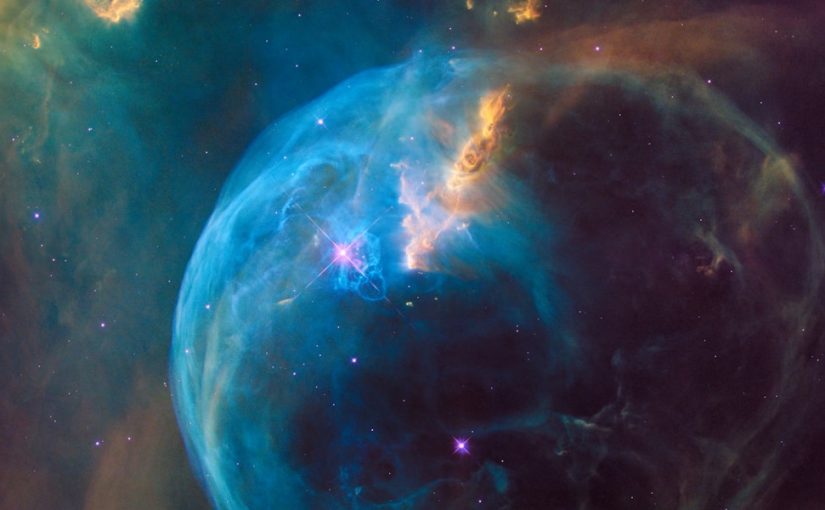
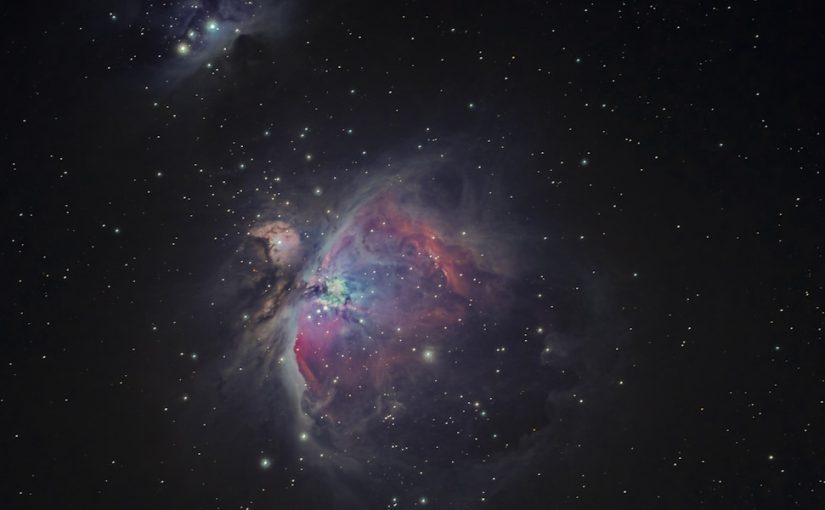
This is what a stellar nursery looks like. A cloud of gas and dust, enriched by the deaths of earlier stars, collapsing slowly under its own gravity, lighting up with new suns. Somewhere in a cloud like this, the material that would become you was being gathered together.

Born From the Ashes of Dead Stars

The Sun is one of those later stars. It is a second or third generation star, born about four and a half billion years ago from a cloud of gas that had already been enriched by the deaths of earlier suns. The Earth formed at the same time, condensing from the same cloud, a ball of rock and metal that included within it the carbon and oxygen and iron and all the other heavy elements that generations of dead stars had made. And then, over billions of years, on the surface of that small, warm, wet rock, chemistry became biology, and biology became complexity, and complexity became consciousness, and eventually became you. So when you look at your hand, you are looking at the recycled remains of ancient stars. The iron in your blood was forged in a supernova. The calcium in your bones was made in the core of a star that died before the Sun was born. You are not merely in the universe. You are made of the universe, built from its oldest and most worked-over material, and the history of the cosmos is written in your very substance.

Back to the First Fire

Keep rewinding now, past the formation of the Sun, past the earlier generations of stars, back toward the beginning, and the universe itself begins to change. The stars grow fewer, then vanish, because there was a time before the first star, a time when the universe was dark, filled only with cooling gas and the fading glow of the Big Bang. Go back further and the universe grows hotter and denser. The atoms themselves cannot exist anymore, because it is too hot for electrons to bind to nuclei, and the cosmos is a plasma, a fog of charged particles through which light cannot travel. Go back further still, and the first nuclei are forming, hydrogen and helium assembling themselves in the first three minutes. Further, and there are no nuclei, only a seething soup of fundamental particles. Further, and the universe is so hot and dense that the forces of nature themselves are merged, indistinguishable, and physics as you know it has not yet settled into its present form. And then you reach it, the edge of what can be known, the moment when our current theories fall silent. The Big Bang. The beginning of the expansion, the beginning of space and time as we understand them, thirteen point eight billion years ago. The oldest light in the universe, the afterglow of that first fire, is still travelling, still detectable, and it is the furthest back you can see.

The Moon hanging in a dark sky
The Moon keeps the old time. Its craters are records of impacts from the era when the solar system was young and full of debris. It has watched over the Earth since before life began, patient and unchanging, a calendar written in stone.

推荐

The Universe Contemplating Itself

Now run the film forward. This is the astonishing part, the part that should stop you in your tracks. From that first fire, through thirteen point eight billion years of expansion and cooling and structure forming, through the first atoms and the first stars and the first galaxies, through generations of stars living and dying and enriching the cosmos with heavy elements, through the formation of one ordinary star in one ordinary galaxy and one small rocky planet around it, through billions of years of chemistry and evolution on that planet's surface, the universe has been moving, with a kind of terrible and beautiful inevitability, toward this moment. Toward the moment when a collection of its own atoms, arranged in a pattern of extraordinary complexity, would open its eyes and look back at the universe and begin to understand it. You are that moment. You are the universe, having become complex enough to contemplate itself. When you study physics, when you work out the orbit of a planet or the behaviour of a wave or the structure of an atom, it is not a small creature studying a vast universe. It is the universe, through you, studying itself. The equations you solve are the universe's own laws, becoming known to themselves, through the only instrument that has ever been able to know them, a mind.

Physics as Homecoming

This is why physics is not merely a subject, not merely a thing you study for an examination, but a kind of homecoming. When you learn that the same gravity that pulls an apple to the ground holds the Moon in orbit, you are discovering a unity that was always there, a connection between the small world of your hand and the great world of the sky. When you learn that the light from the Sun is the product of nuclear fusion, you are learning the source of the warmth on your face. When you learn that the elements of your body were forged in stars, you are learning your own origin story, a story that is true, that is confirmed by evidence, that is more beautiful than any myth, and that belongs to you whether or not you ever sit an examination. Physics is the discipline of remembering what you are made of and where you came from. It is the universe telling you your own history.

Stars scattered across deep space
Every one of these stars is a furnace, and every one of them is scattering the elements of future worlds into the dark. Most of them will never know that their ashes will one day become eyes that look back at them.

Thirteen Point Eight Billion Years Old

And so, when you sit down to a physics problem, when you take out your pencil and look at the question and feel that familiar mixture of excitement and dread, I want you to remember what you are. You are not just a student taking a test. You are thirteen point eight billion years old, in the sense that the matter of your body is thirteen point eight billion years old, and every atom in you has a history that stretches back to the first moments of the cosmos. You are made of star-stuff, assembled on a small rocky planet around an ordinary star, in a galaxy of two hundred billion stars, in a universe of two trillion galaxies. The odds of your existing at all, of that unbroken chain of ancestors surviving, of that cloud of gas collapsing at the right moment, of that asteroid missing or hitting, are so small as to be almost meaningless. And yet here you are, and you are conscious, and you can understand the very universe that made you. This is the most remarkable fact I know. And the examination, the medal, the university, the career, all of it is secondary to that. Those things matter, but they matter because you matter, and you matter because you are the universe, awake, looking at itself, and trying, with all the stubbornness and the love and the brilliance you can muster, to understand what it sees.

Look Up

So the next time the night sky is clear, go outside and look up. Look at the stars, really look, and remember that you are looking at your own ancestry, at the furnaces that made you, at the clouds your atoms drifted in before they became part of the Earth. Remember that the light reaching your eyes left those stars years ago, decades ago, centuries ago, and that you are seeing the past, because light takes time to travel, and the sky is a museum of old light. Remember that you belong to this scene, that you are not separate from it, that you grew out of it the way a wave grows out of the ocean. And remember that in a few billion years the Sun will swell and redden and the Earth will change, and the stars you see tonight will have moved and died and been replaced, and the cosmos will go on making new stars and new worlds and, perhaps, new minds to look up and wonder. The story that produced you is still being written. It will continue long after you. And for this brief, improbable, luminous interval, you are here, and you are aware, and you can read the story. That is enough. That is everything.

The first light of a sunrise over the horizon
Every sunrise is a small echo of the first light, the moment the universe cooled enough for atoms to form and the fog to clear and the light to travel freely. You are seeing, each morning, a reminder of the beginning.
The Earth seen from space against the darkness
All of human history, every person who ever lived, every problem you will ever solve, happened on this small blue world, suspended in the dark. It is the only home we have ever known, and physics is how we learned to take care of it, and of each other, and of the story that made it.
A deep blue night sky scattered with stars
And when the journey backwards is done, you arrive here, at the present, at yourself, at the desk and the pencil and the problem. You came from all of that. Now go forward. The universe is curious to see what you will do next.
推荐
Online Customer Service
Contact Customer Service