
Physics is, at its core, a mathematical science. The laws of nature are written in the language of mathematics, and the ability to wield that language fluently is what separates students who merely understand physics from those who can truly do physics. For students preparing for the British Physics Olympiad (BPhO), mathematical mastery is not optional — it is the foundation upon which every successful solution is built. In this article, we provide a comprehensive guide to the mathematical tools that every aspiring BPhO participant needs to master, organised by topic with practical advice on how to develop each skill.


Why Mathematics Matters So Much in the BPhO
Before diving into specific topics, it is worth understanding why mathematics is so central to the BPhO. Unlike A-level exams, which often reward recall and routine application, the BPhO demands that students:
Set up mathematical models from verbal or diagrammatic descriptions of physical situations
Manipulate equations symbolically — not just numerically — to derive general results
Handle calculus and differential equations in contexts where A-level students might only use algebra
Make approximations judiciously — knowing when a small-angle approximation is valid, or when a term can be neglected
Present solutions clearly with logical derivations, correct notation, and proper units
A student who understands the physics but struggles with the mathematics will consistently underperform. A student who is mathematically fluent — even if their physics intuition is still developing — will be able to extract marks from almost every question. The good news is that mathematical fluency can be developed through deliberate practice.
1. Algebra: The Foundation of Everything
Algebra is the bedrock of olympiad mathematics. Every single problem in the BPhO requires algebraic manipulation, and errors here cascade through entire solutions. Key skills include:
Solving equations: Linear, quadratic, and simultaneous equations must be second nature. You should be able to solve these quickly and accurately, even under time pressure.
Rearranging formulae: The ability to isolate any variable in any equation is essential. Practice rearranging equations symbolically — not just plugging in numbers.
Algebraic manipulation: Expanding, factoring, simplifying expressions, and handling fractions confidently. Many olympiad problems require several steps of algebraic manipulation before the physics becomes clear.
Indices and logarithms: Laws of indices, exponential functions, and logarithmic manipulation appear frequently in thermodynamics, radioactive decay, and wave phenomena.

How to develop this skill: Work through algebra problems daily. Use resources like Isaac Physics (isaacphysics.org) for targeted practice. When solving BPhO past papers, pay particular attention to any algebraic errors you make — these are almost always preventable with more practice.
2. Calculus: The Language of Change
Calculus is the mathematical language of change and motion — and since physics is fundamentally about how things change, calculus is indispensable. While A-level courses introduce basic differentiation and integration, the BPhO requires a significantly deeper level of fluency.
Differentiation
Basic rules: Power rule, product rule, quotient rule, and chain rule must be automatic.
Applications: Finding maxima and minima (crucial for optimisation problems), related rates, and interpreting derivatives as physical quantities (velocity as derivative of position, current as derivative of charge, etc.)
Higher derivatives: Second derivatives appear in acceleration, in the analysis of oscillations, and in stability analysis.
Integration
Basic techniques: Integration by substitution, integration by parts, and partial fractions.
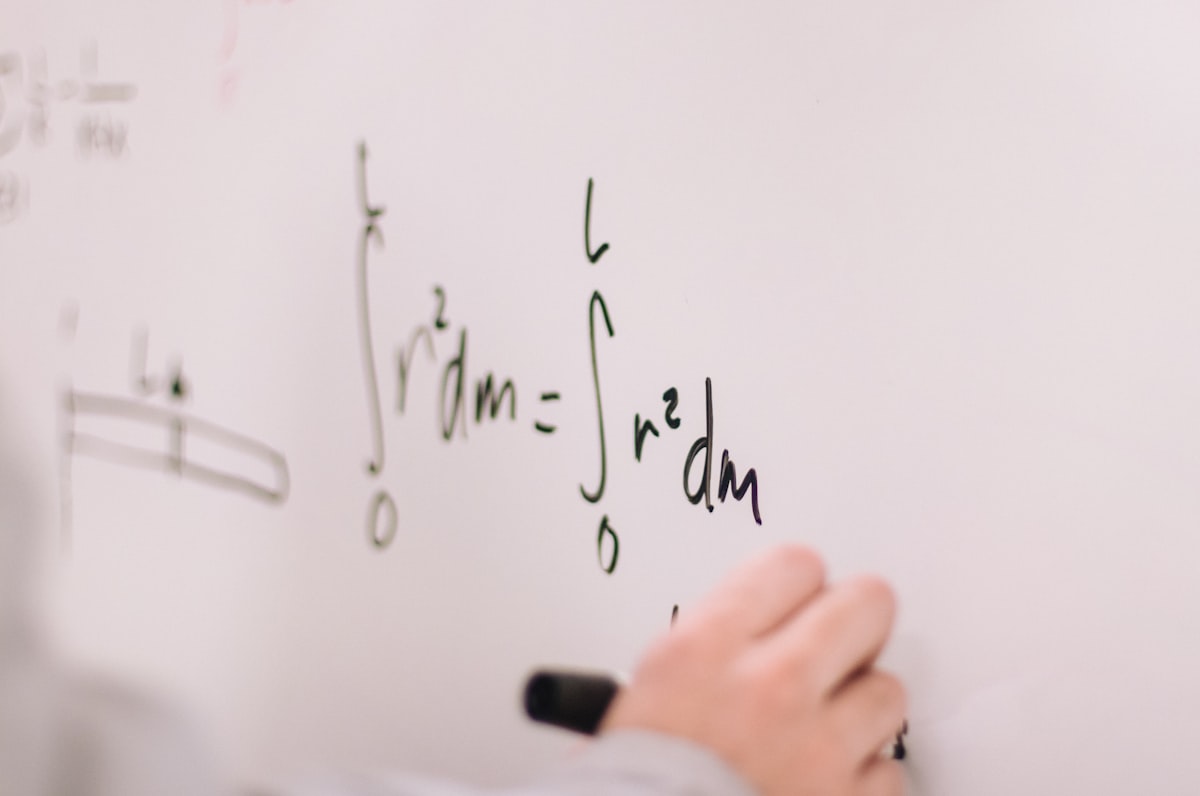
Physical applications: Calculating work done (integral of force), centre of mass (integral of position weighted by mass), total charge (integral of current), and many more.
Definite integrals: Evaluating integrals with limits is a daily task in physics — from computing the area under a force-distance graph to finding the total energy emitted over a range of frequencies.
Differential Equations
Many physical laws are expressed as differential equations — equations relating a quantity to its own rate of change. The BPhO expects familiarity with:
First-order ODEs: Radioactive decay (dN/dt = −λN), RC circuits (charging and discharging), Newton's law of cooling.
Second-order ODEs: Simple harmonic motion (d²x/dt² = −ω²x), damped oscillations, and driven oscillators.
Separation of variables: The most important technique for solving the differential equations encountered in the BPhO.
How to develop this skill: Work through A-level Further Mathematics calculus material, then progress to introductory university-level calculus texts such as Kreyszig's Advanced Engineering Mathematics or Stephenson's Essential Mathematical Methods. Practice by deriving the equations of motion for mechanical and electrical systems from first principles.
3. Vectors: The Geometry of Physics
Vectors are fundamental to physics. Forces, velocities, electric fields, magnetic fields — all of these are vector quantities, and the ability to add, subtract, and resolve vectors is essential for almost every area of the BPhO syllabus.
Vector addition and subtraction: Both geometrically (triangle and parallelogram rules) and analytically (components).
Resolution into components: Breaking vectors into perpendicular components (typically x and y, or radial and tangential) is one of the most powerful techniques in physics problem-solving.
Scalar (dot) product: Used in calculating work done (W = F · s), power, and flux.
Vector (cross) product: Used in calculating torque (τ = r × F), magnetic force on a moving charge (F = qv × B), and angular momentum.
How to develop this skill: Practice resolving forces, velocities, and fields into components for every mechanics and electromagnetism problem you encounter. Work through vector geometry problems that require you to find angles, distances, and resultant vectors.
4. Trigonometry: Angles, Waves, and Oscillations
Trigonometry appears throughout the BPhO — particularly in mechanics (inclined planes, projectile motion), waves (interference, diffraction), and oscillations (SHM). Key skills include:
Right-angled triangles: SOH CAH TOA, Pythagoras' theorem, and the ability to find unknown sides and angles quickly.
Trigonometric identities: sin²θ + cos²θ = 1, double angle formulae, sum and difference formulae. These appear constantly in wave interference problems.
Sine and cosine rules: For non-right-angled triangles, which frequently appear in vector geometry and mechanics problems.
Small-angle approximations: sinθ ≈ θ, cosθ ≈ 1 − θ²/2, tanθ ≈ θ for small θ (in radians). These are invaluable in pendulum problems, optics, and many other contexts.
How to develop this skill: Memorise the key identities and practice applying them in physical contexts. Work through wave interference and diffraction problems, which are essentially applied trigonometry.
5. Graphs and Data Analysis
The ability to interpret, construct, and extract information from graphs is tested in every BPhO paper — and is particularly important for the experimental component of the IPhO.
Reading graphs: Understanding what the gradient, area under the curve, and intercepts represent physically.
Sketching graphs: Being able to sketch the expected shape of a graph based on the underlying physics, including key features like maxima, minima, and asymptotes.
Linearising relationships: Taking logs, reciprocals, or other transformations to convert non-linear relationships into linear form — essential for data analysis.
Error bars and uncertainty: Plotting and interpreting error bars, determining best-fit lines, and estimating uncertainties from graphical data.
How to develop this skill: Practice sketching graphs for physical relationships (e.g., velocity-time graphs for different types of motion, charging/discharging curves for capacitors). When working through past papers, pay attention to any graph-based questions and practice extracting information from them quickly.
6. Complex Numbers and Exponentials
While complex numbers are not a dominant feature of the BPhO, they appear in several important contexts — particularly in AC circuit analysis and wave phenomena.
Complex numbers: Representation in the form a + bi, modulus and argument, Euler's formula (e^(iθ) = cosθ + i sinθ).
Phasors: Using complex numbers to represent oscillating quantities — particularly useful for AC circuits and wave interference.
Exponential functions: e^x appears everywhere in physics — from radioactive decay to capacitor charging to the Boltzmann factor in thermodynamics.

How to develop this skill: If your A-level course does not cover complex numbers, study them independently — they are not difficult and are extremely useful. For exponentials, practice deriving and applying the equations for exponential decay, RC circuits, and thermal physics.
7. Dimensional Analysis and Order-of-Magnitude Estimates
These are not strictly "mathematical" techniques, but they are mathematical thinking at its most powerful — and they appear repeatedly in the BPhO.
Dimensional analysis: Checking that both sides of an equation have the same dimensions, deriving the form of physical relationships, and identifying errors in your working. This is one of the most powerful sanity-check tools available.
Order-of-magnitude estimation: The ability to estimate quantities to within a factor of 10 or 100 — sometimes called "Fermi problems." These appear as short-answer questions in Section A of Round 1.

How to develop this skill: Practice dimensional analysis on every equation you encounter — check the dimensions, and if they don't match, find the error. For Fermi problems, practice estimating quantities like "How many piano tuners are there in London?" or "What is the mass of the atmosphere?" The key is to break the problem down into manageable sub-problems and make reasonable estimates at each stage.
8. Putting It All Together: The Mathematician's Mindset
Beyond specific techniques, there is a mathematical mindset that characterises successful BPhO students. This mindset includes:
Symbolic thinking: Working with variables and equations rather than numbers whenever possible. Numbers come at the end — and only if the question specifically asks for them.
Elegance seeking: Looking for the simplest, most elegant solution rather than the first solution that comes to mind. Often, a clever choice of coordinates or a clever substitution can turn a seemingly impossible problem into a straightforward one.
Precision: Being meticulous about signs, units, and significant figures. Many marks are lost to careless errors that could have been avoided with a more disciplined approach.
Verification: Checking your answers by considering limiting cases, special cases, and dimensional consistency. If your expression for the period of a pendulum doesn't reduce to the known result when the angle is small, something has gone wrong.
Recommended Mathematical Resources
Here is a curated list of resources for developing the mathematical skills outlined above:
For Building Foundations
Isaac Physics (isaacphysics.org) — excellent for targeted practice on specific topics, including the mathematical skills needed for physics
Exam-Matrix / TLMaths — YouTube channels with excellent A-level and Further Maths tutorials
Engineering Mathematics by K.A. Stroud — a classic, self-teaching text that covers all the mathematics you will need
For Advanced Study
Advanced Engineering Mathematics by E. Kreyszig — comprehensive coverage of calculus, differential equations, linear algebra, and more
Mathematical Methods for Physicists by Arfken and Weber — the standard reference for the mathematics of physics at university level
Schaum's Outline series — excellent for practice problems in calculus, differential equations, and complex variables

A Practical Plan for Mathematical Development
Here is a suggested plan for developing the mathematical skills outlined above, organised by timeline:
Months 1–3 (Summer before Year 13): Focus on calculus and vectors. Work through A-level Further Mathematics material on differentiation, integration, and complex numbers. Practice resolving vectors in mechanics problems.
Months 4–6 (Autumn term): Focus on differential equations and trigonometry. Learn to solve first and second-order ODEs by separation of variables. Practice applying trigonometric identities in wave and oscillation problems.
Months 7–9 (Spring term): Focus on graphical methods and dimensional analysis. Practice sketching and interpreting graphs. Apply dimensional analysis to check your solutions in past papers.
Months 10–12 (Summer before university): Continue to develop all skills through past papers and advanced textbooks. The goal is for all these mathematical techniques to become automatic — so that you can focus on the physics when solving problems.
Final Thoughts: Mathematics as a Gateway
Mathematics is not just a tool for solving BPhO problems — it is a gateway to deeper understanding. The student who can fluently manipulate equations, solve differential equations, and think in vectors and complex numbers is a student who can see the structure of physics clearly, appreciate the beauty of its laws, and tackle problems that others find impossible.
Invest in your mathematical skills, and you will find that physics becomes not just easier, but more beautiful. The equations will start to sing. The solutions will start to reveal their elegance. And the problems that once seemed impenetrable will start to yield their secrets.
The mathematics is waiting. Pick up your pen, open your notebook, and begin.
For mathematical resources and past papers, visit the British Physics Olympiad or explore Isaac Physics.